BLOG
2026.04.14
When you hear the word “ammonia,” what kind of image comes to mind?
A sharp, pungent smell? A raw material for fertilizers? A substance that seems difficult to handle? All these impressions are not incorrect. For many years, ammonia has supported society as a raw material for fertilizers and chemical products. Today, however, ammonia is attracting renewed attention as a new energy source that supports a decarbonized society. With the characteristic of emitting no CO₂ during combustion, it is being researched and implemented worldwide as a potential driver of change in the way energy and logistics are structured.
Mitsui O.S.K. Lines (MOL) has been addressing this transformation from two perspectives: transporting ammonia and using it as a fuel. Under its management plan, “BLUE ACTION 2035,” the MOL Group positions its environmental strategy as one of its core strategies and sets GHG emission reduction targets in the “MOL Group Environmental Vision – BLUE ACTION 2035 Phase 2”.
In this article, we introduce the forefront of these efforts from MOL’s perspective, starting with the fundamentals of what ammonia is.
What Is Ammonia? Why It Is Gaining Attention as a Decarbonized Energy Source
 First, let us outline the fundamental characteristics of ammonia and why it is attracting attention as an energy source for a decarbonized society.
Ammonia (NH₃) is a chemical compound composed of nitrogen and hydrogen. It is a colorless gas with a strong, pungent odor and has long been used worldwide as a raw material for fertilizers and as a basic material in the chemical industry.
One of the key reasons ammonia has regained attention in recent years is that it emits no carbon dioxide (CO₂) when combusted. For this reason, it is expected to serve as a carbon-free fuel in the power generation and maritime sectors. In addition, because it can be easily liquefied and transported using existing infrastructure, ammonia is also regarded as an important hydrogen carrier.
The Current State of the Value Chain Supported by Ammonia Transportation
Next, we will introduce the role MOL plays in the field of maritime transportation, which is essential to realizing an ammonia-based society. Through actual projects and demonstration initiatives, we take a closer look at MOL’s efforts in ammonia transportation.
To realize an ammonia-based society, maritime transportation infrastructure capable of safely and efficiently transporting large volumes is indispensable. Leveraging the expertise it has cultivated through years of transporting ammonia for fertilizer use, MOL is working to enable the large-scale transportation of fuel ammonia.
In 2025, MOL announced an agreement on the basic terms of long-term charter contracts for two Very Large Gas Carriers (VLGCs) to transport low-carbon ammonia for JERA Co., Inc. Under this project, low-carbon ammonia produced at Blue Point*1 in Louisiana, United States, will be transported to JERA’s Hekinan Thermal Power Station in Aichi Prefecture. This marks Japan’s first commercial-scale low-carbon ammonia transportation project and represents a major step toward building a large-scale value chain.
Furthermore, MOL is deeply involved not only in maritime transportation itself, but also in the development of the entire ammonia value chain—from production, storage and supply, and maritime transportation, to storage, supply, and end use. In addition to participating in overseas production projects, MOL successfully conducted a Ship-to-Ship (STS) ammonia transfer demonstration in 2024, through which it advanced the verification of operational procedures and associated risks.
(*1)
Blue Point is the name of one of the world’s largest low-carbon (blue) ammonia production projects currently underway in Ascension Parish, Louisiana, USA. The project is led by CF Industries, the world’s largest ammonia producer, with participation from Japan’s JERA and MITSUI & CO., LTD.
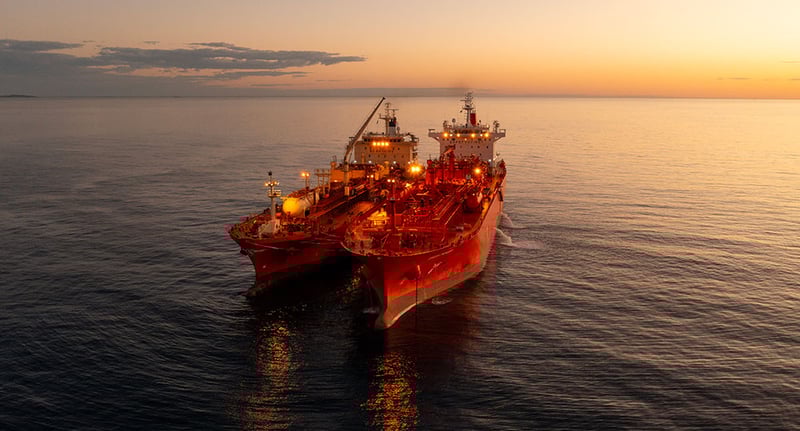 Ship-to-Ship (STS) demonstration of ammonia transfer between vessels (Source: MOL Press release)
In January 2026, a newly built VLGC ENERGIA GRANDEUR was delivered to serve TotalEnergies. The vessel is designed to transport both LPG and ammonia, and has been developed as part of the “BLUE” Series fleet, which uses alternative fuels with a lower environmental impact as its main fuel.
The new hull design combines MOL’s corporate color, “BLUE,” with “Turquoise,” which represents the company’s environmental initiatives, expressing its commitment to the realization of a sustainable society. In addition, the vessel is equipped with a shaft generator to improve operational efficiency and reduce greenhouse gas (GHG) emissions. From a financing perspective, MOL has adopted a transition‑linked loan*2 , reflecting its environmentally conscious approach from multiple angles.
(*2)
A Transition‑Linked Loan is a form of financing in which loan terms—mainly interest rates—are linked to a company’s progress in transitioning toward decarbonization (carbon neutrality). As a type of sustainable finance, it is used in particular to support realistic transition efforts in high‑emitting, hard‑to‑abate sectors.
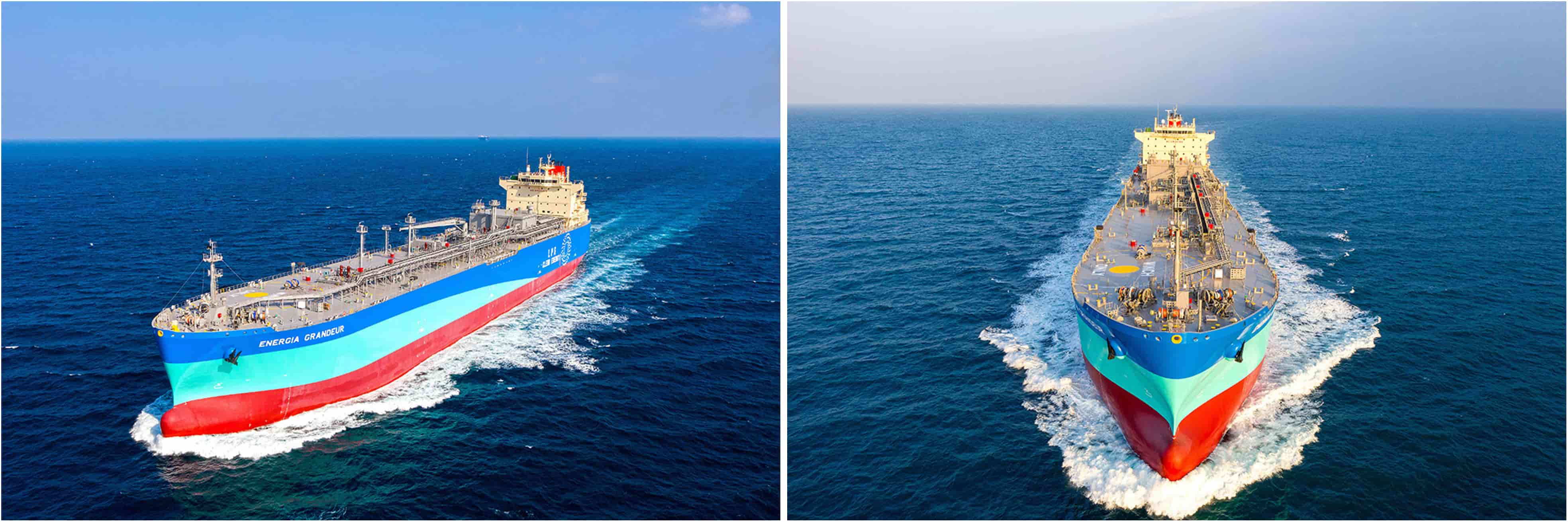
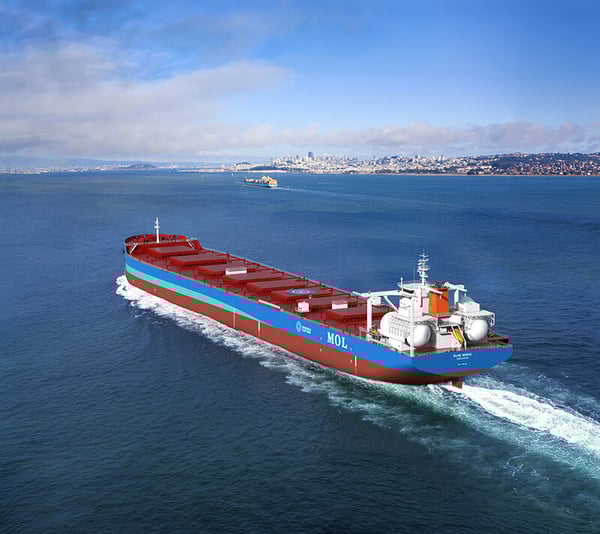
The newbuild LPG Carrier (LPG-DF) "Energia Grandeur" (Source: MOL Press release)
Advancing the Future of Shipping with Ammonia‑powered Vessels
Building on its efforts in ammonia transportation, MOL is expanding its initiatives to use ammonia as a marine fuel. Here, we introduce the latest development initiatives in this area.
MOL is also engaged in the development of vessels that use ammonia as fuel. In 2025, a large-size ammonia-powered ammonia carrier, jointly developed by MOL, Namura Shipbuilding Co., Ltd., and Mitsubishi Shipbuilding Co., Ltd., received Approval in Principle (AiP) from Nippon Kaiji Kyokai (ClassNK) for its ammonia fuel compatible design.
This new vessel design features a cargo tank capacity larger than that of conventional large carriers (VLGCs/VLACs) while enabling the use of ammonia fuel for its own operations, with the aim of significantly reducing greenhouse gas emissions. In particular, the vessel has been designed to meet port restrictions at major power plants in Japan and to be compatible with domestic cargo handling facilities, making it suitable for introduction in Japan. Safety related to the toxicity of ammonia has been given the highest priority in the design process, and appropriate measures have been implemented based on hazard identification (HAZID) risk assessments.
In addition, the vessel is planned to be equipped with MOL’s proprietary Wind Challenger system, which utilizes wind propulsion. Alongside fuel conversion, this system is intended to further reduce greenhouse gas emissions by lowering overall fuel consumption.
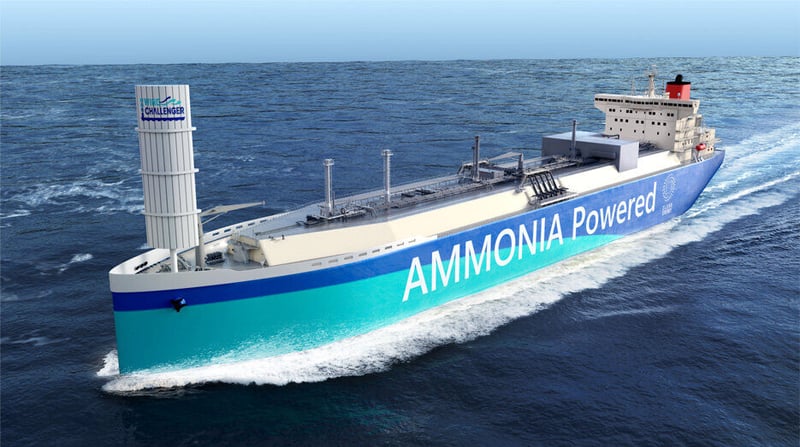 Concept image of a large ammonia carrier powered by ammonia fuel and equipped with the Wind Challenger system (Source: MOL press release)
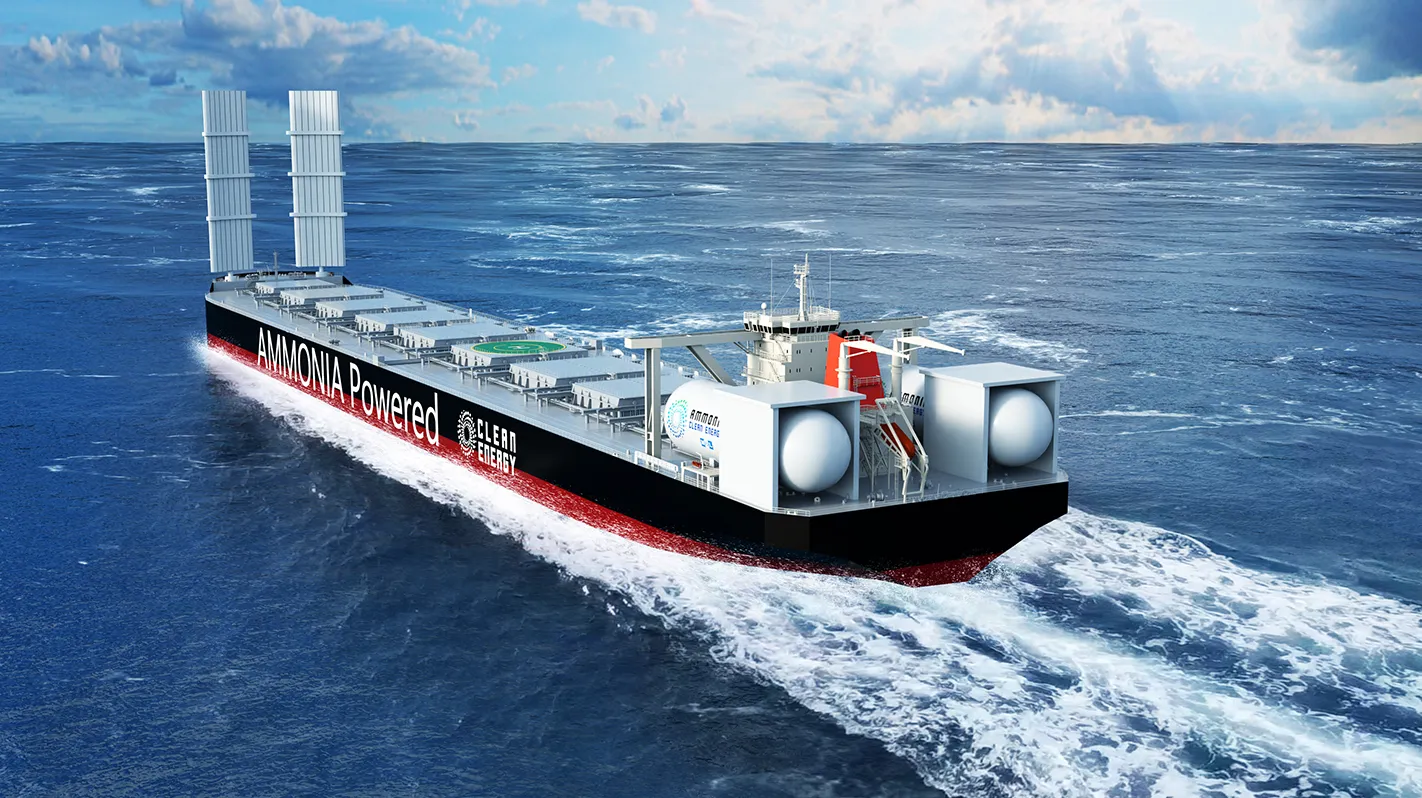
As a further major step, in March 2025, MOL decided, together with Belgium-based CMB.TECH NV, to develop a total of nine vessels, including three Capesize bulk carriers that will be able to operate using ammonia as their main fuel—the world’s first of their kind.
Of these vessels, five are ammonia dual-fuel vessels, while the remaining four are ammonia‑ready vessels designed with a future conversion to ammonia fuel in mind, through which we will advance our decarbonization initiatives in a phased manner.
This project also covers chemical tankers operated by MOL Chemical Tankers (MOLCT), a group company of MOL, with the vessels scheduled to enter service sequentially by 2029. By putting ammonia fuel into practical use, MOL aims to further accelerate the decarbonization of the shipping industry.
CG rendering of ammonia-powered vessel (Source: MOL Press release)
MOL’s Path Toward Decarbonization with Ammonia
Ammonia is an essential energy source for realizing a decarbonized society, and its value chain serves as a critical part of social infrastructure, connecting energy, industry, and logistics. Leveraging its global network as a comprehensive shipping company and its extensive track record in transporting diverse forms of energy, MOL contributes to the realization of a decarbonized society as a provider of critical social infrastructure involved across the entire value chain, from upstream to downstream.
Positioning ammonia as a next-generation clean fuel, MOL is promoting the development and introduction of ammonia-powered vessels, as well as the construction of transportation and supply infrastructure. At the same time, MOL is actively participating in the formation of a global ammonia value chain, strengthening collaboration with partner companies while also focusing on technological development and ensuring safety.
Going forward, the MOL Group will continue to work together as one to help pave the way towards a sustainable future.
ADOPT ALTERNATIVE FUELS (Newly released on April 1, 2026!)
Mitsui O.S.K. Lines (MOL) is focusing on the introduction and examination of a wide range of alternative fuels for vessels, and is steadily promoting efforts to reduce greenhouse gas (GHG) emissions from vessels. We also highlight our initiatives related to ammonia fuel.