BLOG
2026.03.31
Cars are an essential component in the smooth running of our cities, daily lives, and industries. When vehicles cross borders and are delivered to distant destinations, car carriers —vessels that have continued to evolve over time— play an important role in their transport. Mitsui O.S.K. Lines (MOL), was the first shipping company in Japan to launch car carrier operations, and has led this sector since 1965. From the groundbreaking RORO system to today’s massive vessels capable of handling a wide variety of vehicles, MOL has consistently pushed forward the norms for ‘vehicle transportation’.
Today, MOL stands at the forefront of building a clean supply chain for the future, introducing innovations such as the use of Bio-LNG fuel. In this blog, we will explore the origins of car carriers, their history of innovation, and the vision for sustainable logistics that harmonizes with the environment.
Read on to explore this dynamic world and discover how MOL is shaping the future of global transportation.
Birth of a Transport Revolution — The History of Car Carriers and the RORO System
As Japan’s automobile industry started to achieve global growth, the “marine transportation” for delivering products overseas faced significant challenges.
Although Japan’s automobile exports began in earnest in the late 1950s, at that time completed vehicles were loaded one by one onto conventional cargo ships using cranes. This method required an enormous amount of time and effort for loading and unloading, posed a high risk of cargo damage during voyages and handling, and, because vehicles could not be stacked, resulted in extremely poor transport efficiency.
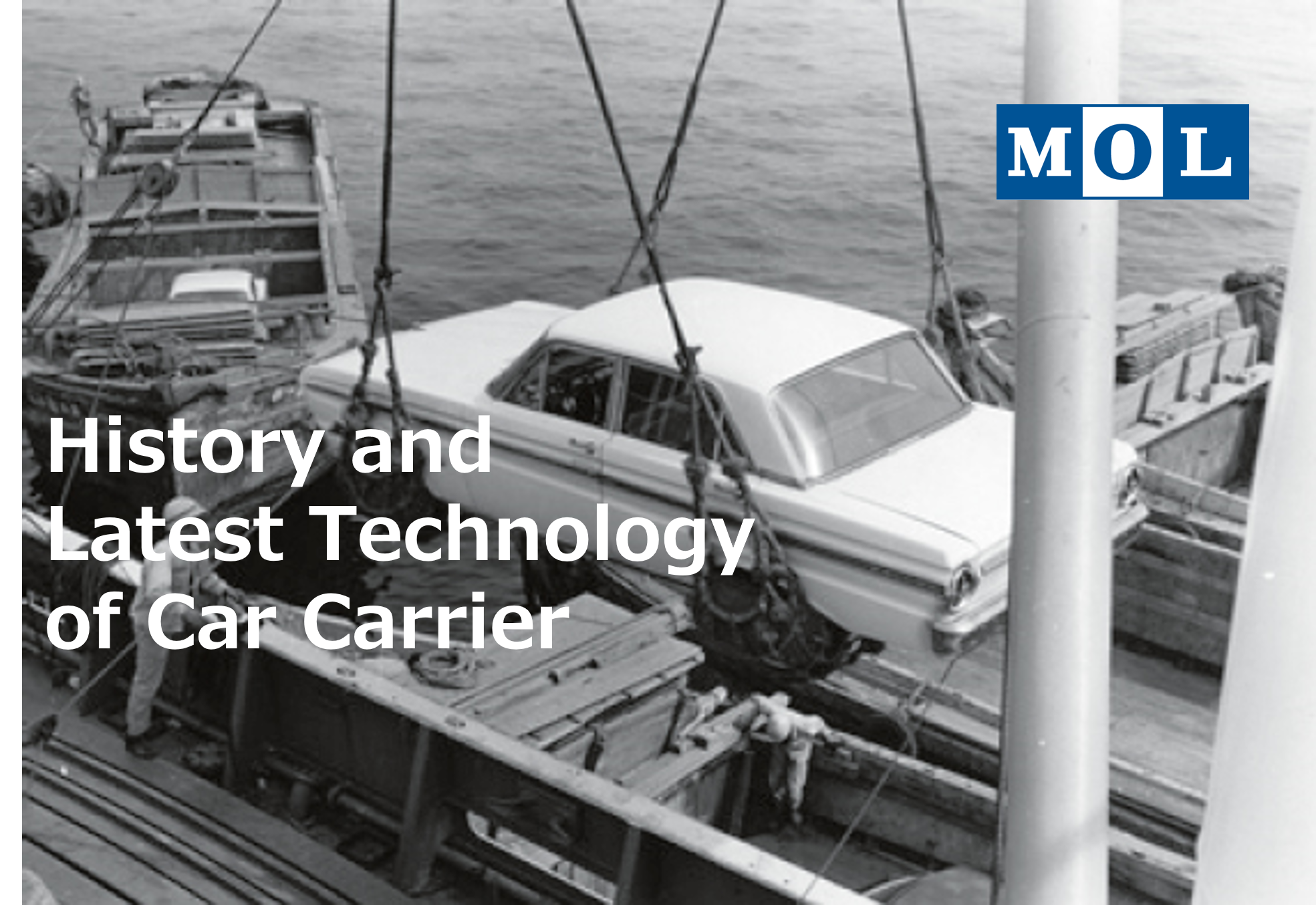
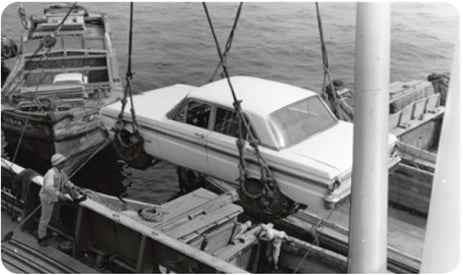 Before the Development of the RORO System: Scenes of Cargo Handling (Source: MOL A Vessel for Every Need Supporting Everyday life and Industries Around the World )
The Birth of a Pioneer (1965)
To meet the growing demand for automobile exports and ensure the safe and efficient transport of cargo —primarily finished vehicles— a dedicated vessel was developed: the pure car carrier (PCC).
In 1965, MOL became the first shipping company in Japan to launch a car carrier. This marked a major turning point in the history of Japan’s transport of automobiles.
Japan’s first dedicated vessel, the Oppama Maru, introduced the then-revolutionary “roll-on/roll-off (RoRo) method” for cargo handling and began service with a capacity of 1,200 vehicles.
The “RORO Method” That Transformed Logistics
The true revolution in automobile transport came with the “roll-on/roll-off (RORO) method,” a completely new concept in cargo handling.
Instead of lifting vehicles with cranes, this method uses a ramp —a sloped passage connecting the ship and the quay— allowing vehicles to drive on and off the vessel under their own power.
This groundbreaking method was realized through joint research between cargo owners and MOL. With the introduction of the RORO method, cargo handling time was dramatically shortened compared to conventional methods, and the risk of cargo damage was significantly reduced —delivering major benefits to the industry.
%20(1).jpg?width=857&height=511&name=%E6%97%A5%E6%9C%AC%E5%88%9D%E3%81%AERORO%E6%96%B9%E5%BC%8F%E3%82%92%E6%8E%A1%E7%94%A8%E3%81%97%E3%81%9F%E3%80%8C%E8%BF%BD%E6%B5%9C%E4%B8%B8%E3%80%8D%20(2)%20(1).jpg)
The Oppama Maru, the first ship in Japan to use the RoRo method (Source: MOL A Vessel for Every Need Supporting Everyday life and Industries Around the World )
MOL, as a pioneer in automobile transport, today provides an efficient and safe transport service globally through a fleet of about 100 vessels operated by the group.
What began with a vessel capacity of 1,200 vehicles has evolved into massive ships designed to carry all types of self-propelled cargo, from ordinary passenger cars to construction machinery. Today, these vessels can transport up to 7,000 vehicles at a time when converted to small-car equivalents.
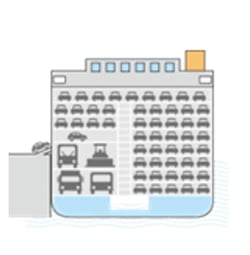
A ship with a structure like a parking lot, allowing vehicles to drive on and off for loading and unloading, enabling highly efficient transportation.(Source: MOL A Vessel for Every Need Supporting Everyday life and Industries Around the World )
Accommodating Diverse Vehicles: The “FLEXIE Series”
The evolution of car carriers goes beyond simply increasing loading capacity. To meet the growing need to transport a wide variety of vehicles, such as large buses and construction machinery, greater flexibility has been pursued.
Launched in 2018, MOL’s FLEXIE Series consists of car carriers with a capacity of 6,800 vehicles, designed to flexibly accommodate diverse cargo types. Inside the vessel there are 14 deck levels, six of which are height-adjustable or “liftable decks”. These, when adjusted, can accommodate cargo up to 5.6 meters in height. In addition, the ramp is engineered to withstand loads of up to 150 tons, enabling the transport of nearly all types of heavy cargo.
The FLEXIE Series, equipped with cutting-edge technology, addresses two major challenges, mass transportation and the handling of a wide range of cargo sizes and weight, making it a vessel perfectly suited to modern logistic needs.
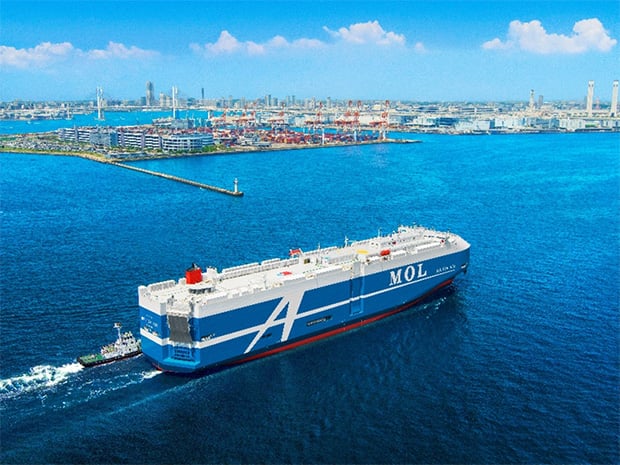 1st car carrier of FLEXIE series, Beluga Ace(MOL press release)
Transporting Cars, Creating the Future! MOL’s New Initiatives
Having revolutionized logistics with car carriers, Mitsui O.S.K. Lines is now taking on its next challenge: protecting the global environment. Our goal is to achieve Net Zero Emissions by virtually eliminating greenhouse gas emissions by 2050. A bold new journey toward this ambitious target has already begun.
A New Hull in Blue and Green — The Arrival of LNG-Fueled Vessels
As an initial step toward this goal, MOL has been introducing LNG-fueled vessels. Compared to conventional fuel oil, LNG-fueled ships can reduce CO₂ emissions by approximately 25%. Leading the way is the CERULEAN ACE, a pioneering vessel that has already brought this new vision of marine transportation to life and is sailing across the world’s oceans today.
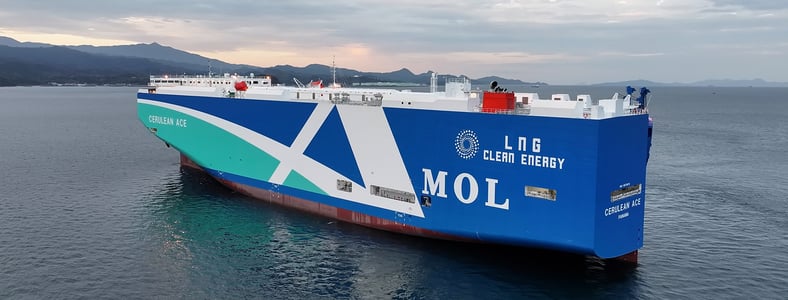 The first vessel of the Blue Series, the LNG-fueled car carrier CERULEAN ACE. Inspired by ‘BLUE,’ it bears the name ‘CERULEAN,’ a Spanish word meaning blue sky or sky blue. (Source: MOL website)
Reducing Environmental Impact: CERULEAN ACE
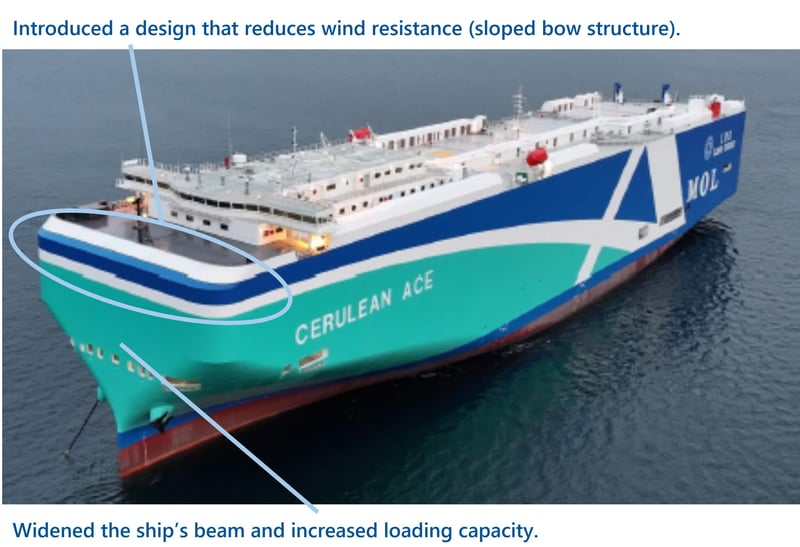
CERULEAN ACE incorporates not only the use of cleaner fuel, but also structural features designed to minimize its environmental impact. For example, the vessel adopts an aerodynamic design that reduces wind resistance by approximately 20%. By introducing a sloped structure at the top of the bow, air resistance during navigation is lowered, contributing to improved fuel efficiency.
In addition, the ship’s beam has been widened from the conventional 32 meters to 38 meters, increasing its loading capacity from about 6,400 vehicles to approximately 7,000. This enhancement significantly boosts transport efficiency, enabling more vehicles to be carried on a single voyage.
State-of-the-art facilities designed for safety and comfort onboard
On the CERULEAN ACE, cameras and an AI system have been installed inside the cargo hold. When the AI detects an abnormality in the footage captured by the cameras, it immediately sends an alert to the crew.
Currently, all of our car carriers are equipped with fire alarm systems (smoke detectors), but this new system enables even faster smoke detection. In addition, because cargo hold footage can be monitored both onboard and from the shore, it enables a quicker initial firefighting response.
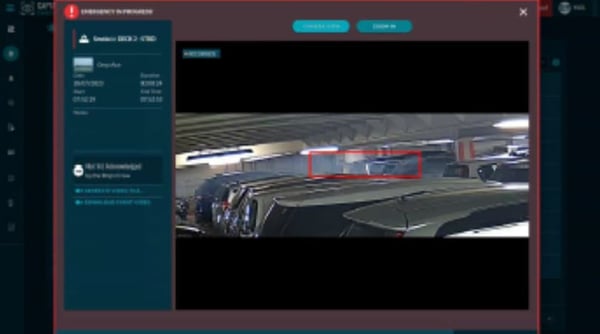
Monitor screen of the AI camera during testing (Source: MOL press release)
Furthermore, to enhance crew comfort, we have introduced a ‘third space’ called IKOI inside the vessel. This is a place that is neither a cabin nor a workplace, but an area for relaxation, especially for long voyages, creating a more comfortable onboard environment.
In addition, in further efforts to improve crew welfare, we have implemented Starlink, a satellite communication service offering high-speed, low-latency connectivity. This ensures a stable Internet environment at sea, enabling smoother communication with family and friends for the crew.
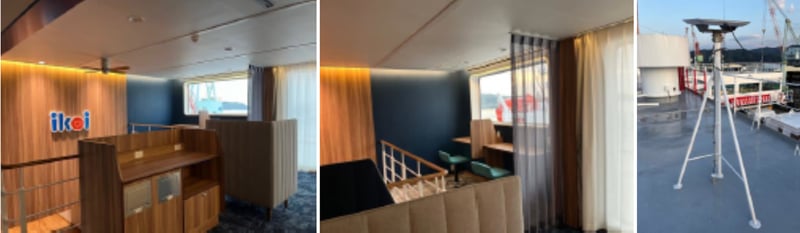 Calm, wood-grain interior (left, center) and the Starlink antenna installed on the vessel (right) (Source: MOL press release)
Driving the Future! Introduction of Bio-LNG Fuel
In March 2025, for the first time on an ocean-going vessel operated by a Japanese shipping company, MOL’s LNG-fueled car carrier CELESTE ACE was supplied with bio-LNG fuel. Bio-LNG fuel, also known as liquified biomethane (LBM), is produced by refining and liquefying biogas. The three key reasons why bio-LNG fuel is attracting attention will be explained in the next section.
CELESTE ACE received approximately 500 tons of bio-LNG fuel from Titan Supply B.V. at the Port of Zeebrugge in Belgium.
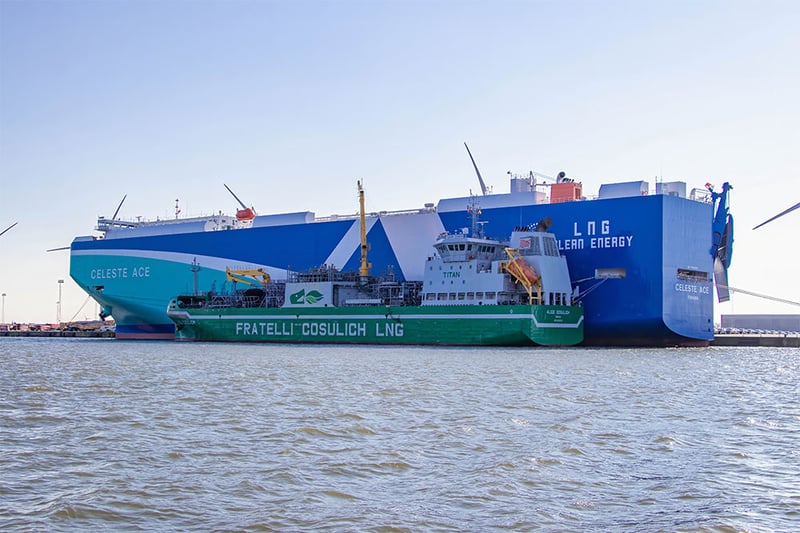 LBM bunkering vessel supplying the Celeste Ace (Source: MOL press release)
Three Reasons Why Bio-LNG Fuel Is Gaining Attention
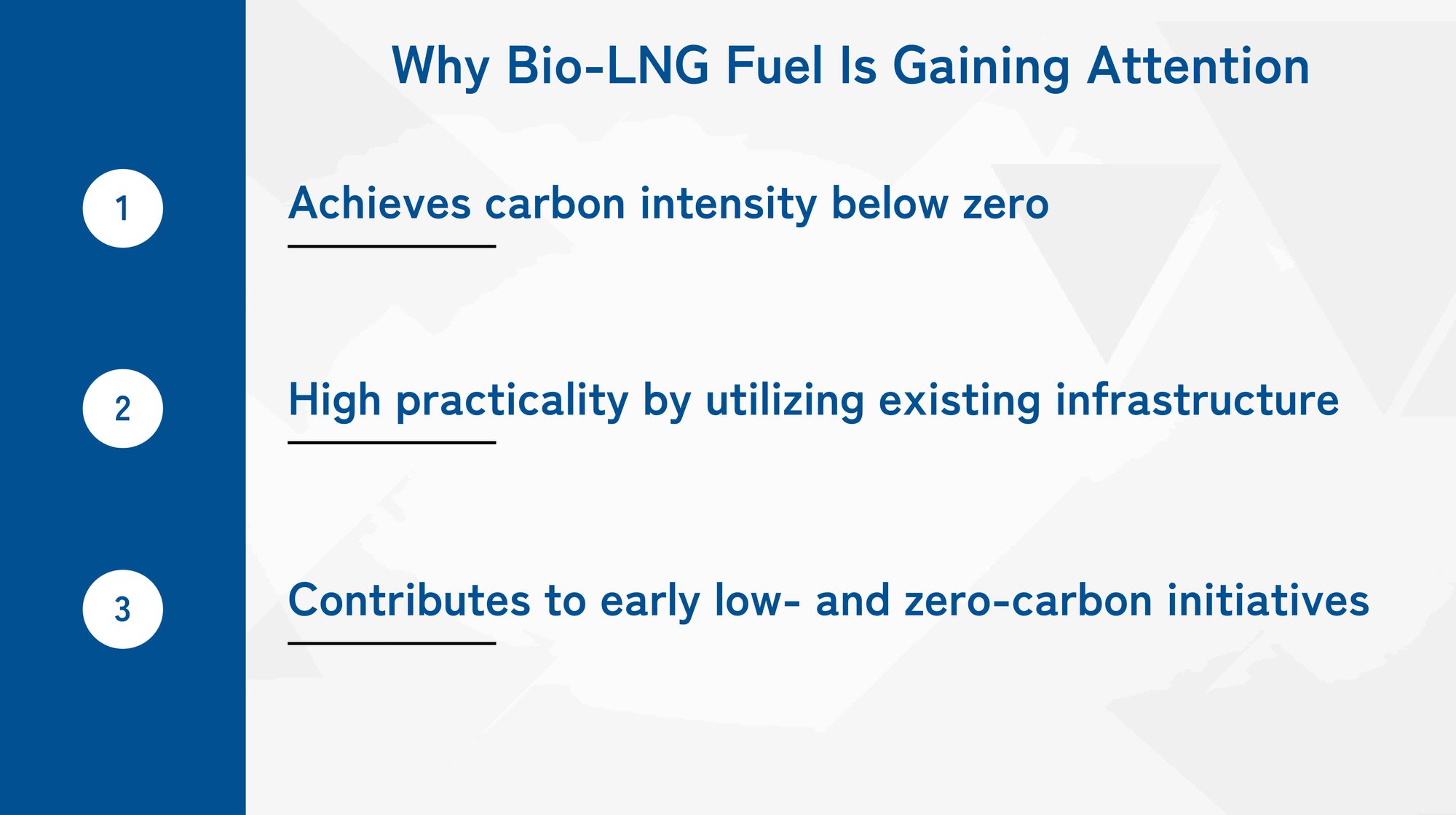
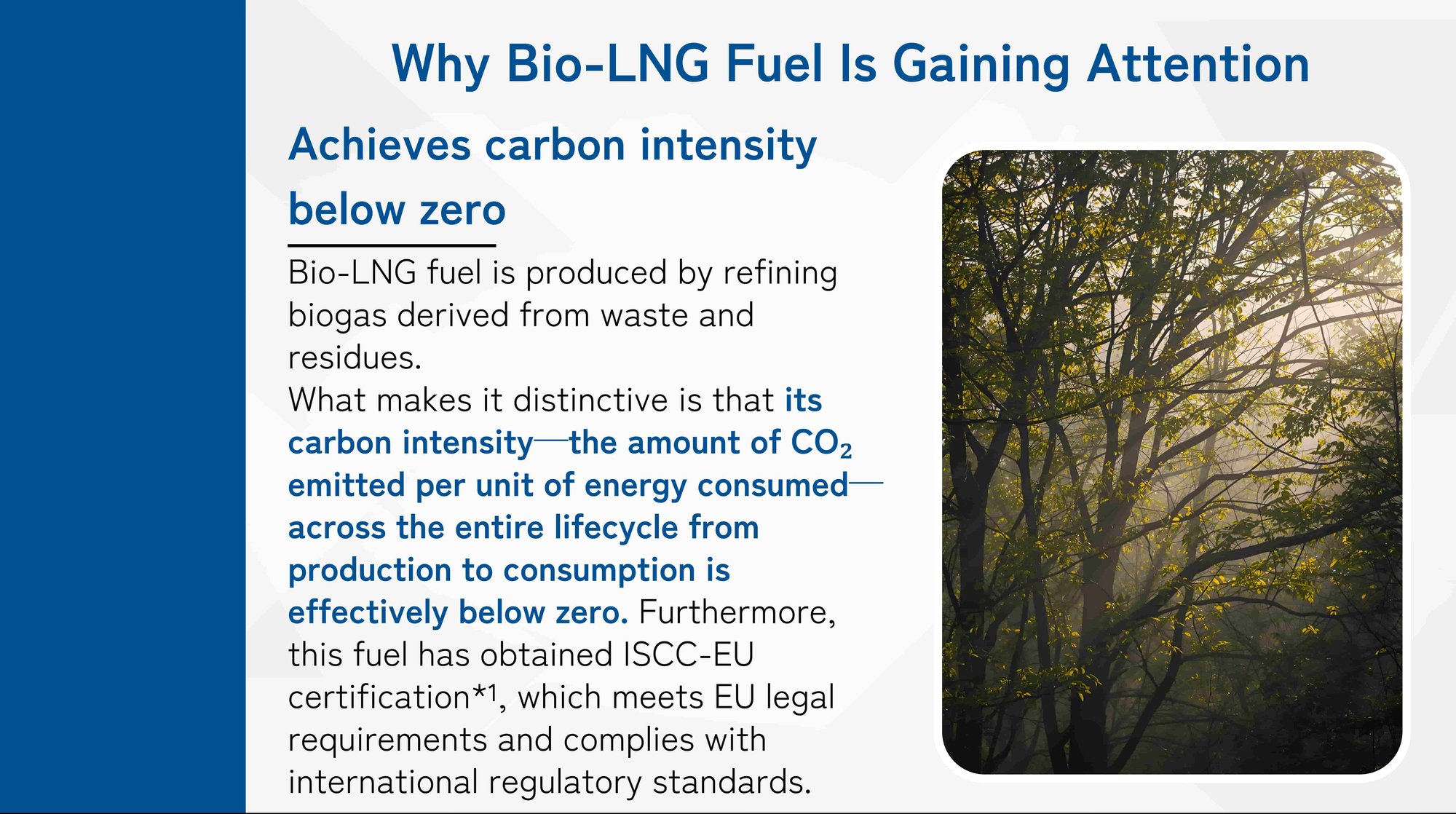
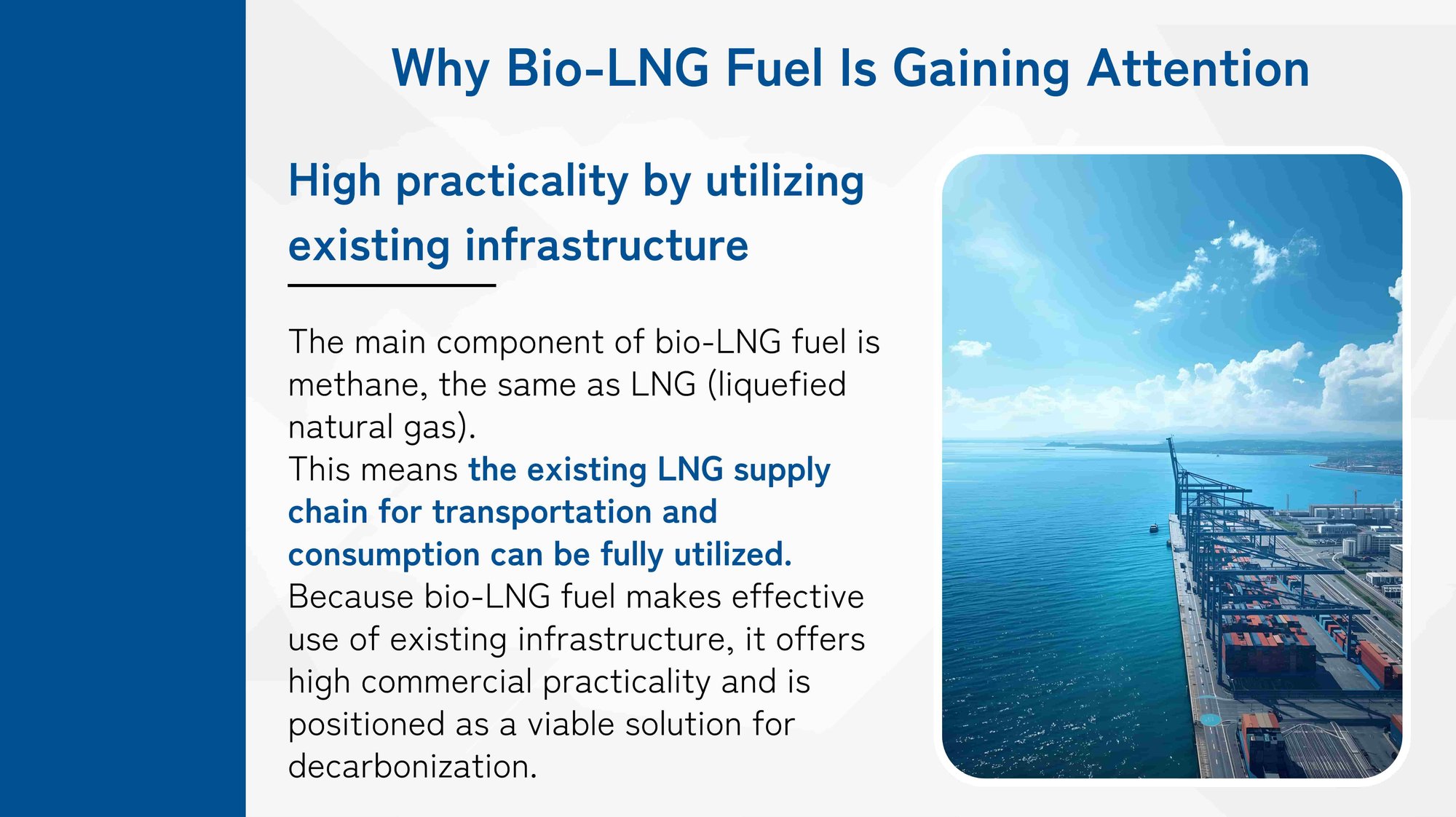
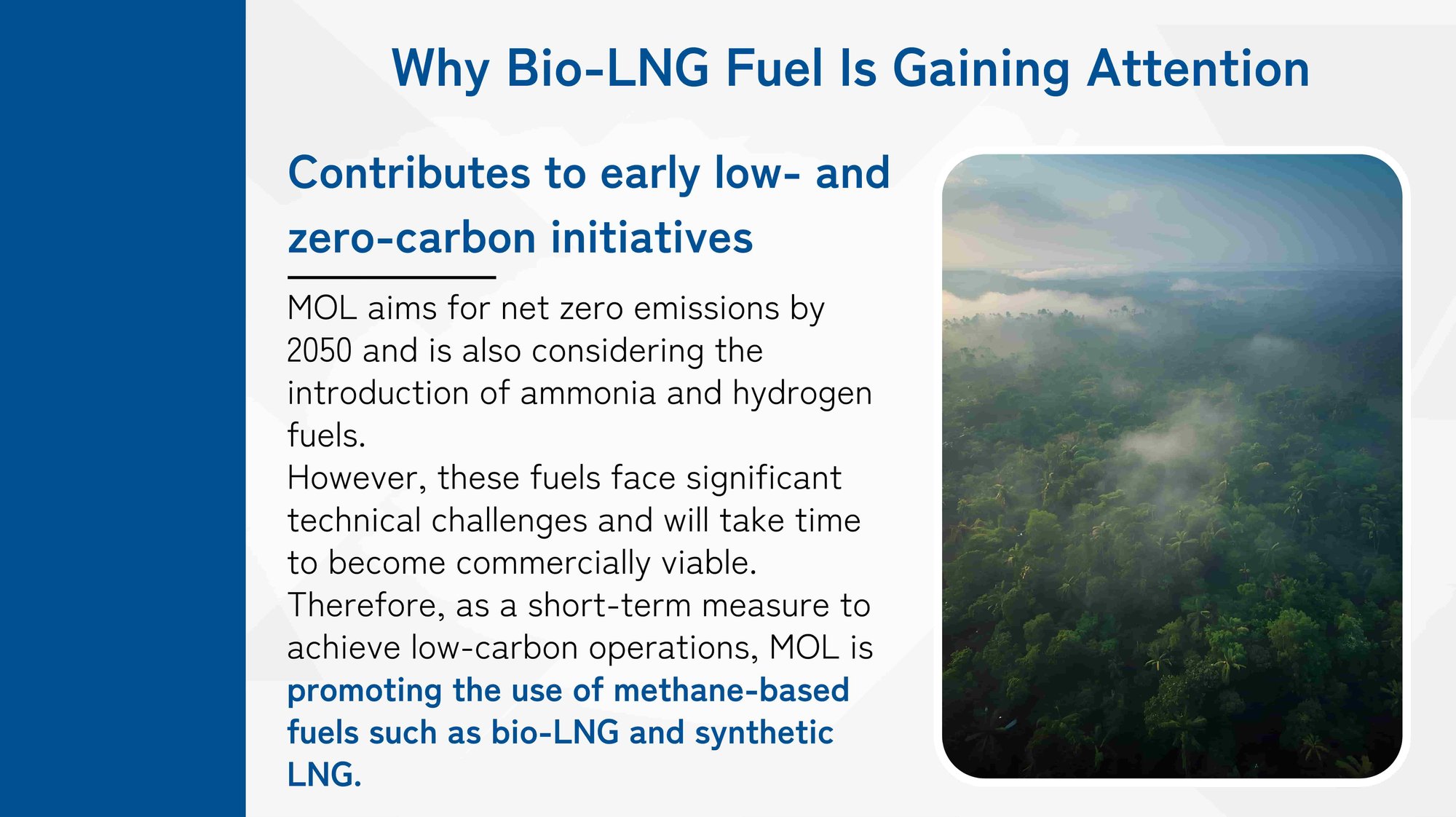
(*1)ISCC-EU Certification (International Sustainability and Carbon Certification) verifies that sustainable fuels made from biomass and waste meet EU legal requirements for sustainability and greenhouse gas emission reduction standards. The certification was established under the European Renewable Energy Directive (RED II).
What Is Book and Claim? Connecting Sustainable Logistics Through Certificates
MOL is accelerating collaborative initiatives with stakeholders involved in marine transportation to achieve net-zero emissions. As part of this effort, we have launched the “BLUE ACTION NET-ZERO ALLIANCE.”
This program enables the environmental attributes of low-carbon voyages using alternative fuels to be traded as certificates, contributing to shippers’ Scope 3 emission reductions. These certificates are traded under the Book and Claim method.
Book and Claim is a method where the greenhouse gas (GHG) reduction value achieved through shipping services using low-carbon fuels , etc., is registered (Book), and customers who receive the allocation can claim (Claim) that reduction value.
With the Book and Claim service, customers can engage in flexible transactions regardless of whether they are physically involved in the low-carbon voyage being traded.
We have also fully launched the Book and Claim service for car carriers. MOL has signed a memorandum of understanding with Be Forward Co., Ltd., which transports used cars to Africa, starting April 2025. This MoU will enable Be Forward to claim the greenhouse gas (GHG) reduction value associated with the use of LNG as fuel in MOL's car carrier fleet as its own GHG reduction through certificates. This contributes to the decarbonization of maritime transport.
MOL continues to introduce newly built LNG-fueled car carriers while striving to reduce GHG emissions for stakeholders and society as a whole, aiming to achieve net-zero emissions by 2050.
To ensure the reliability of this service, MOL underwent an audit by ClassNK (Nippon Kaiji Kyokai) and obtained third-party certification for the Book and Claim methodology. This certification by ClassNK is the first of its kind in Japan’s shipping industry. Certificate issuance will also proceed under ClassNK-certified standards.
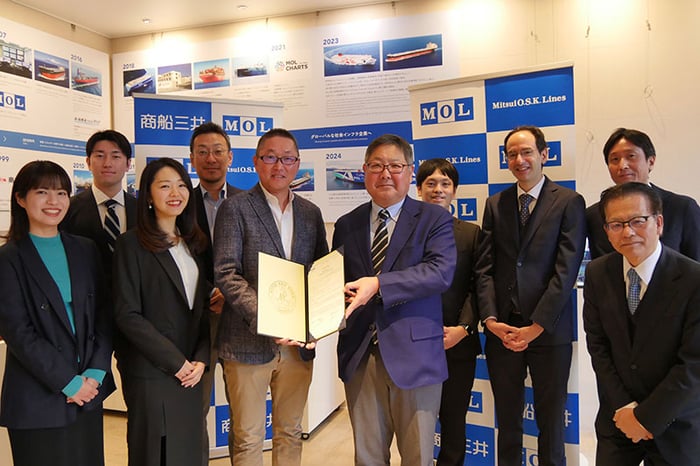 At ClassNK’s validation statement presentation ceremony (Source: MOL press release)
Contributing to the Creation of a Clean Supply Chain
In addition to promoting the use of LNG and biofuels, MOL is also working towards the introduction of next generation clean fuels such as ammonia and hydrogen.
Through initiatives involving alternative fuels and the Book and Claim framework, MOL strives to ensure environmental responsibility while maintaining stable and efficient transportation, fulfilling its role as a strategic partner in building a clean supply chain together with our customers.
Did you enjoy exploring the car carrier world?
If you found yourself thinking, “I want to learn more!”, we also offer opportunities for you to experience the scale and atmosphere of real operations firsthand.
For example, during the "Commemorative Event for Marine Day 2025", held on Monday, 21 July 2025, we hosted an onboard tour of the LNG fueled car carrier CELESTE ACE. Many elementary, junior high, and high school students and their families participated. They toured the bridge and crew living quarters of this massive vessel —approximately 200 meters in length— and through a talk session with active deck officers and engineers, they learnt firsthand about both the role of maritime transport in supporting daily life and the industry's efforts towards decarbonization.
If you have the opportunity, we warmly invite you to join future ship tours!
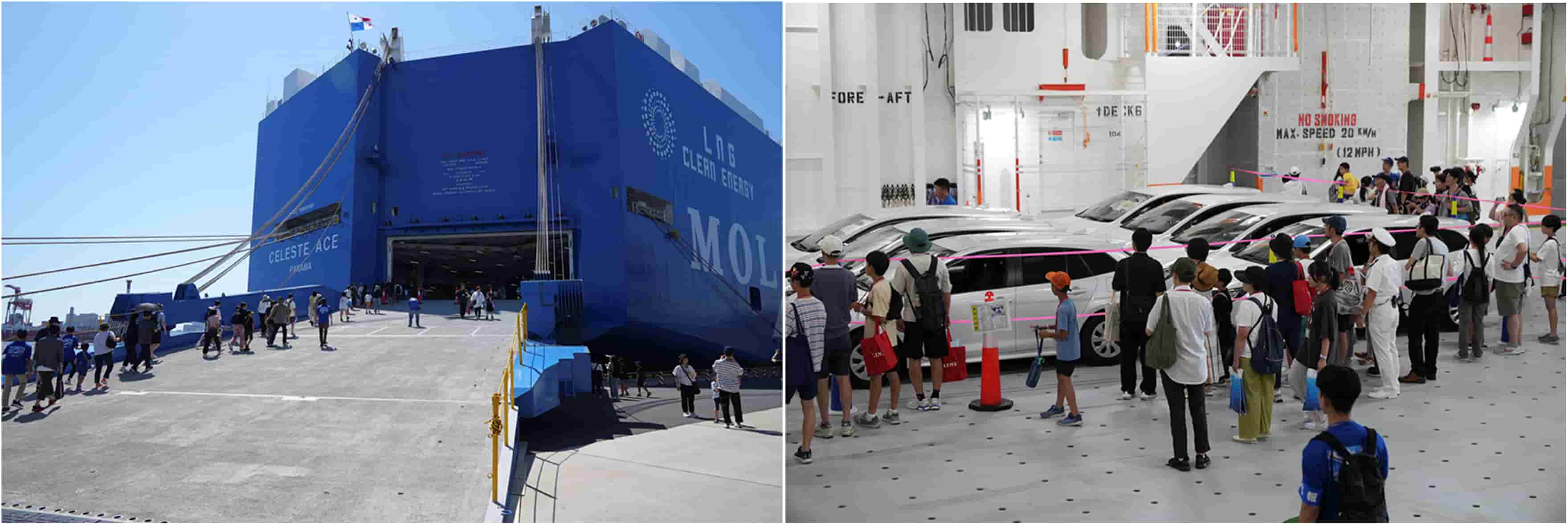
Visitors heading into the vessel and a demonstration of vehicle loading inside the cargo hold (Source: MOL press release)
.jpg)
BLUE ACTION NET-ZERO ALLIANCE(Carbon Inset / Book and Claim Program)
History and Latest Technology of Car Carrier