BLOG
2026.10.01
Maritime transport, which carries approximately 80% of global trade volume, serves as a vital foundation of everyday life and industry. At the same time, it faces the significant challenge of reducing greenhouse gas (GHG) emissions.
Under the “MOL Group Environmental Vision: BLUE ACTION 2035 Phase 2,” MOL has set targets for achieving net-zero GHG emissions across the Group by 2050 and reducing GHG emission intensity from transportation by 45% by 2035 compared with 2019 levels.
To achieve these goals, the Group is advancing initiatives across multiple areas. One such initiative is the DarWIN Project*1 , which aims to reduce GHG emissions from daily vessel operations by improving fuel efficiency. We spoke with Chihiro Ikenaga of the Corporate Sustainability Division and Megumi Sakaue, who was involved in the project’s implementation and verification in the Bulk Resources Business Group Iron and Steel Unit and now works in the Corporate Marketing Division, about the efforts behind this initiative.
(*1)
DarWIN:Digital Approach to Reduce GHG With Integrated Network
.jpg?width=686&height=390&name=%E5%9D%82%E4%B8%8A%E3%81%95%E3%82%93%E6%B1%A0%E6%B0%B8%E3%81%95%E3%82%93%E3%81%8A%E4%BA%8C%E4%BA%BA1(%E5%9C%A7%E7%B8%AE%E3%83%88%E3%83%AA%E3%83%9F%E3%83%B3%E3%82%B0).jpg)
Photo: Left, Megumi Sakaue (Global Strategy Team, Corporate Marketing Division; participated in the DarWIN Project from April 2023 to April 2026 while assigned to the Bulk Resources Business Group Iron and Steel Unit), and right, Chihiro Ikenaga (GHG Digital Management Team, Corporate Sustainability Division).
DarWIN Project and Its Three Approaches
——— First, could you tell us what the DarWIN Project is?
Ikenaga
The DarWIN Project is a company-wide initiative aimed at improving vessel fuel efficiency and reducing GHG emissions. As the project driver, I work with internal and external stakeholders throughout the process, from planning, evaluation, and decision-making on installations to implementation and performance verification.
Sakaue
I was originally responsible for sales within the Bulk Resources Business Group Iron and Steel Unit. Based on proposals developed by Ikenaga's team, my role was to implement these initiatives on bulk carriers operated by MOL.
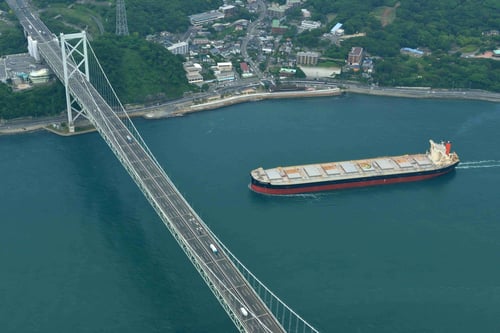 Bulk carrier in operation (Source: Mitsui O.S.K. Lines)
Ikenaga
The goal of the DarWIN Project is to steadily reduce GHG emissions by implementing a series of energy-saving measures on vessels already in operation. The key is not to stop once a measure has been implemented, but rather remain involved throughout the entire process, from preliminary studies to post-implementation reviews that assess the percentage of improvement achieved. We then share the knowledge gained across the company and apply it to further improvements.
Sakaue
One of the key strengths of a company-wide, cross-functional project is the ability to quickly apply insights across business units and vessel types.
%20(1).jpg?width=760&height=428&name=DarWIN%E3%83%97%E3%83%AD%E3%82%B8%E3%82%A7%E3%82%AF%E3%83%88%E5%AF%BE%E5%BF%9C%E4%BA%8B%E4%BE%8B(%E8%8B%B1%E8%AA%9E)%20(1).jpg) DarWIN Project initiatives (Vessel image: AI-generated illustration)
DarWIN Project initiatives (Vessel image: AI-generated illustration)
———Specifically, how do you improve fuel efficiency?
Ikenaga
Our approach is built on three main pillars: (1) Specification Improvements, which enhance the vessel's technical performance; (2) Condition Maintenance, which keeps the vessel in good condition; and (3) Optimal Operation, which optimizes vessel operations. To maximize the benefits of these measures, we combine them with FOCUS*2, a platform for visualizing and analyzing vessel data, and data monitoring, management, and analysis by EcoMOL*3.
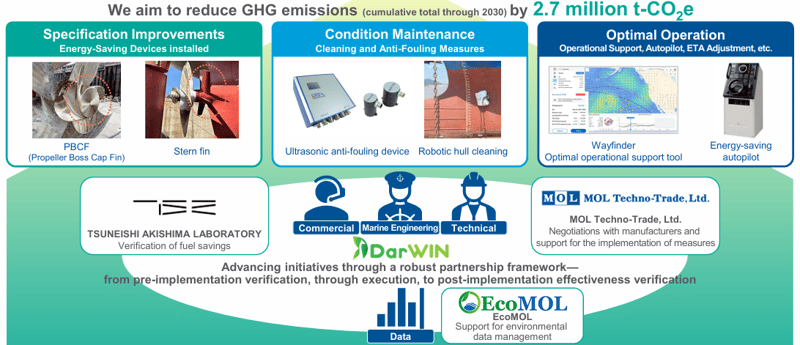 Source: MOL Group Environmental Vision
(*2)
FOCUS (Fleet Optimal Control Unified System): MOL’s integrated vessel data analytics platform that consolidates vast amounts of sensor data and operational reports collected from vessels in service, enabling centralized visualization and analysis of vessel conditions and propulsion performance.
(*3)
EcoMOL: A data management organization based in the Philippines. It is responsible for collecting, analyzing, and visualizing vessel data, supporting decision-making for fuel efficiency improvements and Optimal Operation across MOL’s business divisions.
(1) Specification Improvements: Balancing Safety and Economic Efficiency
——— What specific measures are included under "Specification Improvements"?
Ikenaga
Most of these measures involve physical modifications to vessels. Examples include replacing existing propellers with lighter, thinner propellers optimized for actual operating conditions; installing stern fins — four to five fins fitted ahead of the propeller to straighten the water flow entering it; and adopting PBCF (Propeller Boss Cap Fins), which are installed on the boss cap behind the propeller to improve propulsion efficiency.
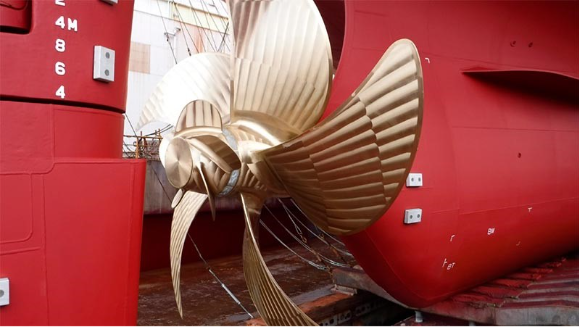
PBCF(Propeller Boss Cap Fins)(Source: MOL website)
———We understand that implementation can also involve challenges such as verifying safety and coordinating with various stakeholders.
Sakaue
When making modifications to a vessel, we proceed carefully, verifying each step to ensure that no issues arise in operation after installation.
This is especially important when introducing a technology for the first time within the company on a lead vessel. In such cases, close alignment is essential between the marine technical teams responsible for safety and the business units seeking to maximize energy-saving benefits.
Take propellers as an example. In recent years, opportunities for vessels to operate at full speed have become less frequent due to contractual terms agreed with customers, compliance with various regulations, and the promotion of energy-efficient operations. However, vessels must still be capable of achieving full-speed performance when circumstances require it. Even when we wanted to introduce lighter propellers better suited to actual operating conditions, there were initially no established criteria indicating how much weight reduction would be acceptable. We therefore worked closely with manufacturers, marine technical teams, and business units to determine the appropriate specifications through careful discussions.
In addition, when installing these technologies on chartered vessels operated by MOL, it is important to proceed with the understanding and cooperation of the shipowners. We take care to explain the measures thoroughly, addressing concerns about safe operation, vessel performance, and potential impacts on crew workload. We also seek their cooperation in arranging dockyard work and supporting on-site activities.
Furthermore, keeping projects on schedule requires close coordination and schedule management among numerous stakeholders, including shipowners and shipyards. I have visited worksites personally and have worked with relevant parties to identify the causes of delays whenever they occurred, building trust-based relationships with stakeholders throughout the process.
.jpg?width=500&height=359&name=%E5%9D%82%E4%B8%8A%E3%81%95%E3%82%93%E3%81%8A%E4%B8%80%E4%BA%BA%20(1).jpg)
Ikenaga
After a modification is introduced, we monitor its performance while the vessel is actually underway, checking its compatibility with the engine and monitoring for any abnormal loads or vibration. Through the growing number of installations and the accumulation of performance reviews, I feel we have been able to address safety concerns as they arise.
(2) Condition Maintenance: Identifying the Best Timing for Maintenance
——— Could you tell us about the measures included under “Condition Maintenance”?
Ikenaga
Specific measures include the use of anti-fouling coatings, which help prevent the buildup of slime, barnacles, and other marine fouling, as well as cleaning, in which divers or robotic systems remove accumulated fouling from the hull.
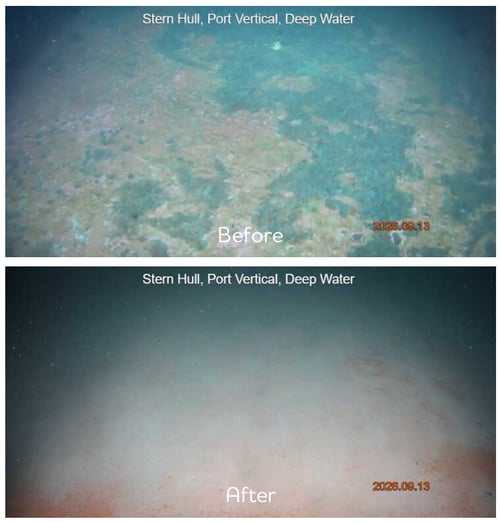 Before and after cleaning (Image courtesy of Neptune Robotics)
Sakaue
One of the most effective measures is anti-fouling coating. Although recoating can only be carried out once every few years, the choice of coating applied to the hull has a significant impact on fuel efficiency. The results we are seeing today are the product of continuous research and incremental improvements in performance by coating manufacturers and our marine technical teams.
Ikenaga
We are also making greater use of data. In the past, decisions on whether cleaning was necessary were made by individual operators. Today, we analyze operational data in FOCUS and use a system that automatically alerts relevant stakeholders when cleaning is expected to be effective.
Sakaue
In the past when I was responsible for vessel operations, we would review voyage analyses and various reports before consulting with the relevant departments and deciding whether cleaning should be carried out. Today, vessel conditions can be visualized through data, and vessels that are expected to benefit from cleaning can be identified objectively. As a result, I believe the accuracy and efficiency of these decisions have improved significantly.
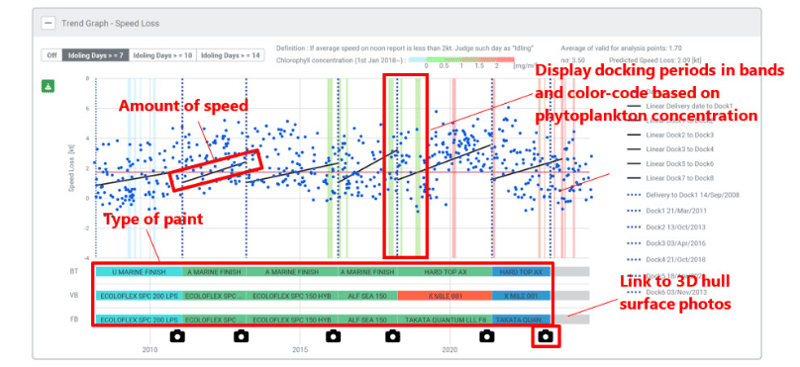
Analysis screen image of “Fouling Analysis,” an application within FOCUS that uses vessel big data to track deterioration in propulsion performance (Source: MOL Press Release)
(3) Optimal Operation: Optimizing How Vessels Are Operated Every Day
——— Could you give us some examples of “Optimal Operation” initiatives?
Ikenaga
At the core of these initiatives is Wayfinder, a tool provided by the U.S.-based company Sofar Ocean. Its most distinctive feature is its ability to collect real-time ocean data, including wave heights and ocean currents, through a network of Spotter Buoys deployed across the open ocean. This data is combined with satellite data to forecast weather and sea conditions. The tool then analyzes this information using AI and data models to provide daily recommendations on the most optimal route and engine RPM for the voyage. According to Sofar Ocean, this approach improves forecasting accuracy by approximately 50% compared with conventional methods that rely solely on satellite data. We are also advancing other initiatives, such as an energy-saving autopilot system that reduces unnecessary course deviations and optimal trim operation, which minimizes hull resistance by adjusting the vessel's trim.
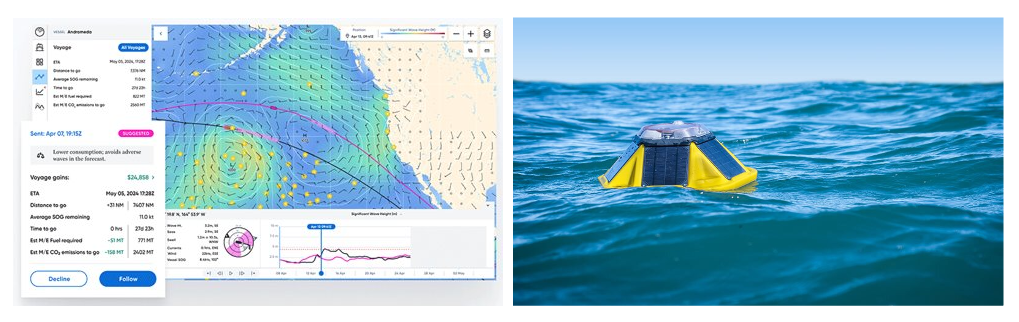
Left: Illustrative display of an optimized route
(black line: actual voyage route; pink line: optimal route proposed by Wayfinder)
Right: Spotter Buoy, an ocean observation buoy developed by Sofar Ocean
(Source: MOL Press Release)
Sakaue
Conventional routing systems primarily focused on recommending which route a vessel should take. Wayfinder goes a step further by providing guidance on how the vessel should be operated. For example, simply increasing engine output when facing a headwind is not necessarily the most effective approach. By taking weather and sea conditions into account, the tool provides daily recommendations on how to reach the destination as economically and safely as possible.
.jpg?width=450&height=384&name=Wayfinder%E4%BD%BF%E7%94%A8%E7%94%BB%E5%83%8F_%E8%AA%BF%E6%95%B4%E6%B8%88(%E8%83%8C%E6%99%AF%E3%82%82).jpg) Reviewing Wayfinder recommendations
Reviewing Wayfinder recommendations
Another important aspect of implementation has been close collaboration with vessel crews. Vessel operations ultimately depend on the crew, and the final decision always rests with the captain. During the early stages of deployment, we made a point of meeting captains, chief officers, and other crew members in person at ports of call to carefully explain why the tool was being introduced.
At the same time, we compared feedback from crews, such as reports that wave conditions were rougher than the forecast had indicated, against actual measurements collected by the buoys. These comparisons have helped improve forecasting accuracy. Through this ongoing communication process, the recommendation adherence rate, which indicates the extent to which Wayfinder’s recommendations are followed, has gradually improved as well.
Achieving a Cumulative Reduction of 170,000 Tons of Fuel Consumption: Measuring Results and Taking the Next Step
——— DarWIN began operating as a company-wide initiative in earnest in October 2023. What results has the project delivered so far?
Ikenaga
.jpg?width=300&height=400&name=%E6%B1%A0%E6%B0%B8%E3%81%95%E3%82%93%E3%81%8A%E4%B8%80%E4%BA%BA%20(1).jpg) In the most recent fiscal year, FY2025, we reduced fuel consumption by approximately 110,000 tons. Since the project began, cumulative fuel savings have reached approximately 170,000 tons. This is equivalent to about 520,000 t-CO2e in GHG emissions. In addition, by the end of FY2025, the project had reached a level at which the resulting savings exceeded the cumulative investment made. In that sense, DarWIN has succeeded in creating both environmental and economic value.
In the most recent fiscal year, FY2025, we reduced fuel consumption by approximately 110,000 tons. Since the project began, cumulative fuel savings have reached approximately 170,000 tons. This is equivalent to about 520,000 t-CO2e in GHG emissions. In addition, by the end of FY2025, the project had reached a level at which the resulting savings exceeded the cumulative investment made. In that sense, DarWIN has succeeded in creating both environmental and economic value.
Behind these results lies steady, data-driven verification. We analyze the fuel-efficiency improvements achieved by each vessel and each initiative, continuously confirming their effectiveness and building on those improvements. By doing so, we hope to further advance our decarbonization efforts.
Sakaue
Originally, DarWIN was based on a model in which MOL made the investment and, in return, realized the benefits from the resulting fuel savings. More recently, we have begun initiatives under which the investment and the resulting benefits are shared equally. One example is our partnership agreement with Rio Tinto, one of the world's largest mining companies. If this approach becomes more widespread, it could lead to broader collaboration with external partners and customers as well. As environmental considerations continue to gain importance both in Japan and overseas, we believe that transporting cargo in a more environmentally responsible manner will become increasingly important in the years ahead.
Ikenaga
Looking ahead, we plan to expand the scope of the project further, including exploring its deployment to vessels that we charter out to other companies, with the goal of achieving a cumulative GHG emissions reduction of 2.7 million t-CO2e by 2030. As the project advances and the volume of data we manage continues to grow, the operational workload also increases. To support faster and more effective decision-making, we intend to further enhance our use of data and AI.
Many Hands Shaping the Future of Shipping
——— Finally, do you have a message for those reading this article?
Sakaue
Even within MOL's fleet, vessels powered by heavy fuel oil still account for a significant share. At a time when attention is often focused on low- and zero-carbon fuels and newbuild vessels, I believe the DarWIN Project plays an important role by addressing a different challenge: how to improve the performance of the vessels already in operation. Because it is an initiative that can deliver both economic benefits and environmental gains, I hope many people will take an interest in it.
Ikenaga
Even installing a single device requires the involvement of many stakeholders. The major results we see today are the outcome of countless small improvements accumulated over time. I hope this project helps more people learn about how MOL is pursuing practical initiatives like these to decarbonize the shipping industry. .jpg?width=600&height=450&name=%E5%9D%82%E4%B8%8A%E3%81%95%E3%82%93%E6%B1%A0%E6%B0%B8%E3%81%95%E3%82%93%E3%81%8A%E4%BA%8C%E4%BA%BA2(%E5%9C%A7%E7%B8%AE).jpg)
The DarWIN Project advances shipping decarbonization through the steady accumulation of practical improvements, one step at a time. The journey continues.

DarWIN Project and EcoMOL -Building an Entirely New Data-Driven Efficient Operation Method-
This article was originally published in January 2025.
The content reflects information available at the time.