BLOG
2026.10.06
Sea Japan 2026, one of the maritime industry's major events, was held in spring 2026. Among the highlights was MOL’s next-generation technology, the Wind Challenger.
Harnessing the power of wind to propel large vessels may evoke the Age of Sail, yet Wind Challenger is an entirely new technology. Based on the presentation delivered at the event, this article provides an easy-to-understand overview of this project, which is attracting attention worldwide.
Why Wind, Again?
Today, the global shipping industry is working toward the ambitious goal of achieving net-zero greenhouse gas (GHG) emissions by 2050. One solution expected to help achieve this goal is the adoption of new fuels. However, this approach faces challenges such as increased fuel costs and the enormous quantities of fuel required.
This led us to focus on the direct use of wind, a natural source of energy, as propulsion. By reducing fuel consumption itself, this technology can be regarded as a key solution for realizing a decarbonized society.
What Is Wind Challenger? A Next-Generation Wind-Assisted Propulsion Technology
For those unfamiliar with Wind Challenger, here is a brief introduction. In simple terms, it is a rigid sailed wind-assisted propulsion system that directly converts wind energy into propulsive force for a vessel.
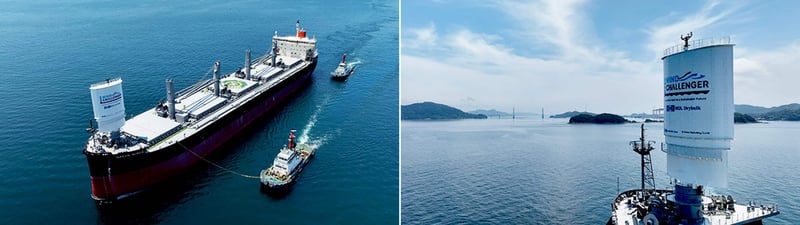 Vessel equipped with Wind Challenger (Source: MOL Press Release)
While sailing ships in the Age of Sail relied on fabric sails, Wind Challenger uses large sails made of robust materials which are utilized in a manner similar to aircraft wings. By using the lift and drag generated when these sails catch the wind, the system reduces engine load and significantly lowers fuel consumption. This is the core mechanism behind the technology.
What distinguishes Wind Challenger from previous wind propulsion technologies is three innovative technologies that are introduced below.
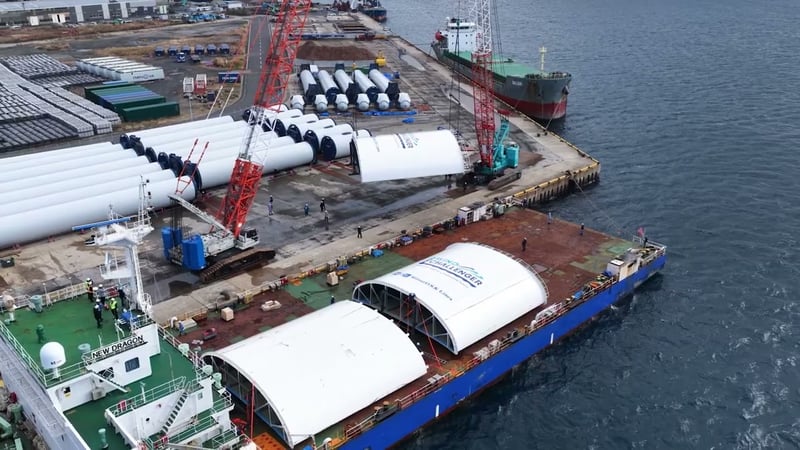 Wind Challenger sail being transported by sea (For details, see ” Delivering the Rigid Wing Sail Across the Sea ~MOL’s Comprehensive Transport Solutions~”)
Innovative Technologies Behind Wind Challenger
The core component of Wind Challenger is its large rigid sail, which rises from the bow of the vessel.
• Telescopic Structure
The sail can be extended or retracted according to operating conditions. When winds are light, it is fully extended to capture as much wind as possible. When winds become too strong or weather conditions deteriorate, it can be retracted to maintain vessel stability. 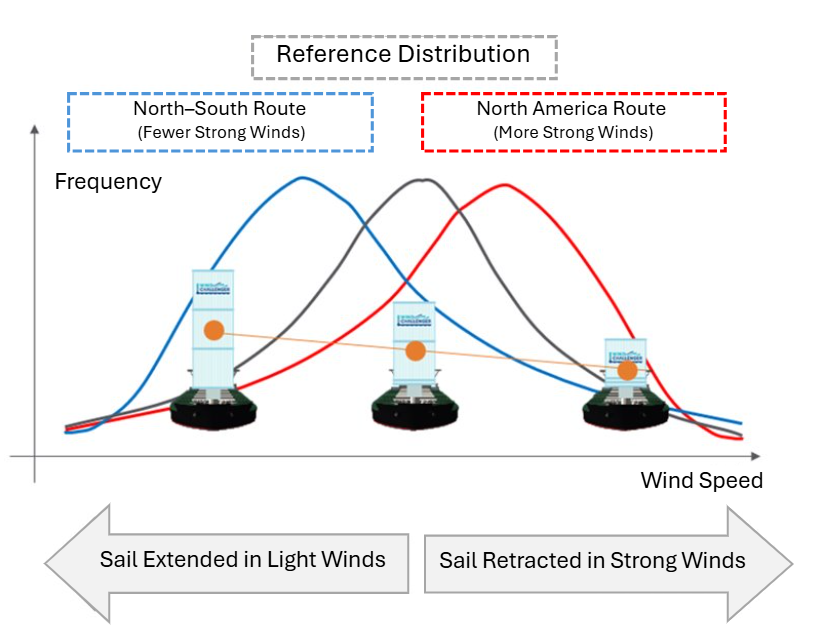
• Lightweight Design Using FRP (Fiber-Reinforced Plastic)
FRP is used as the primary material to support the large sail. This enables significant weight reduction while maintaining structural strength. -png.png?width=1309&height=723&name=%E7%94%BB%E5%83%8F%20(2)-png.png)
Installing FRP panels onto the frame (For details, please refer to the video on theWind Challenger service page.)
• Fully Automated Control and Optimized Routing
The angle and height of the sail are automatically controlled according to wind direction and wind speed. In addition, a proprietary Weather Routing System (WRS) recommends routes that maximize the use of wind propulsion and supports voyage operations.
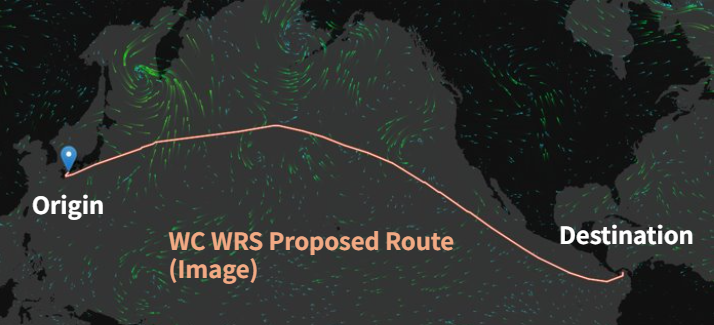
Using models that take sail-generated thrust into account, the system recommends optimal routes based on prevailing weather conditions.
Meteorological and oceanographic data are obtained every six hours.
Expanding Operations: Wind Challenger-Equipped Vessels and a Successful Retrofit
Three dry bulk carriers equipped with Wind Challenger are already operating around the world.
• Shofu Maru:
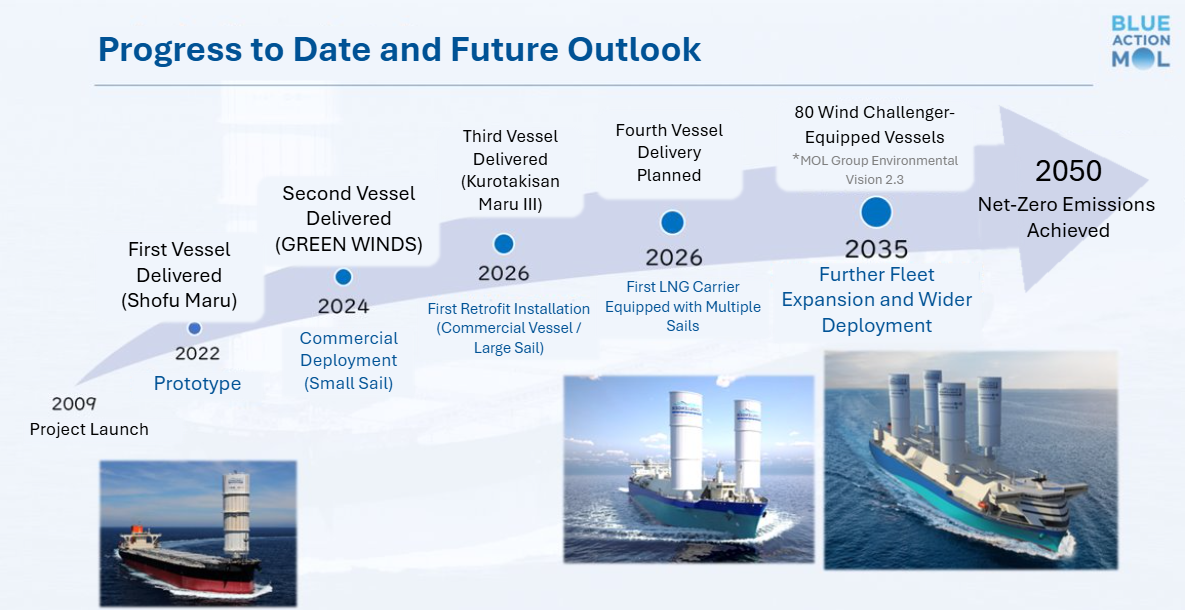
Completed in 2022, Shofu Maru became the first vessel in the world equipped with Wind Challenger. Measurements taken in September 2023 recorded average daily fuel savings of 17%, with instant peak reductions reacheding 30%, demonstrating the effectiveness of the technology.
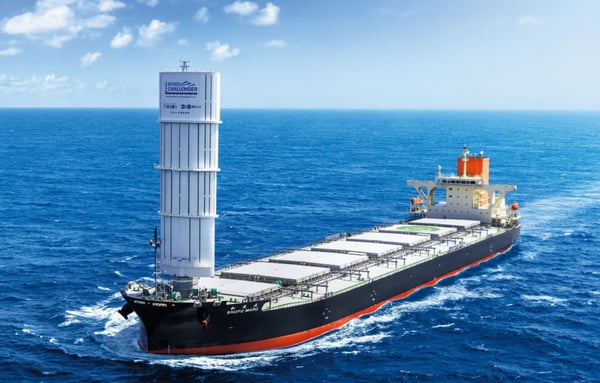 Coal carrier Shofu Maru equipped with Wind Challenger sailing with the sail deployed (Source: MOL Press Release)
• Green Winds:
Completed in 2024, Green Winds operates on global trade routes, including transits through the Panama Canal.
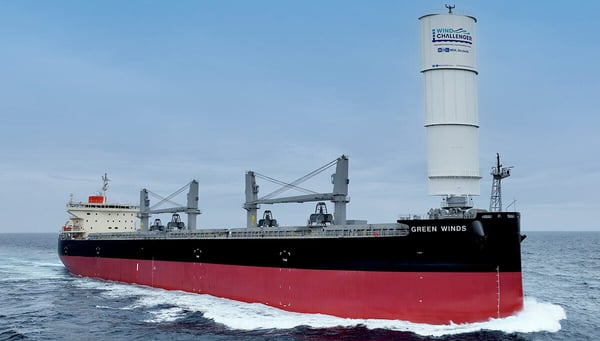
In July 2024, Green Winds, a 64-type Ultramax bulk carrier equipped with cranes, became the world’s first vessel of its type to be fitted with Wind Challenger and entered service. (Source: MOL Press Release)
• Kurotakisan Maru III:
In March 2026, a retrofit installation on an existing vessel was completed. This represented a significant step forward by demonstrating the potential to expand the technology not only to newbuild vessels but also to vessels already in operation.
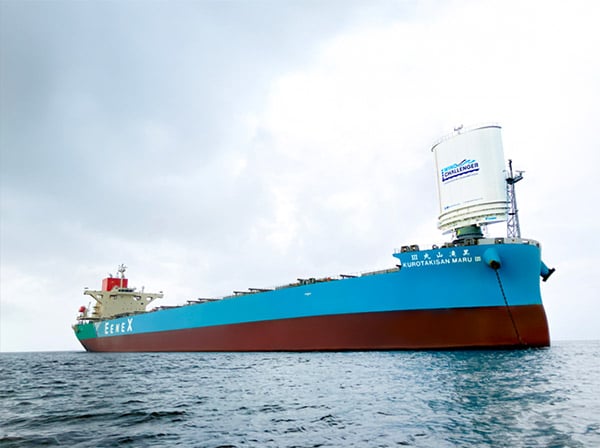
The coal carrier Kurotakisan Maru Ⅲ equipped with the Wind Challenger
(Source: MOL Press Release)
Green Winds transiting the Panama Canal
Continuing Development: Multiple Sails and Dedicated Vessel Designs
The development of Wind Challenger continues apace.
In September 2026, an LNG carrier equipped with two Wind Challenger sails is scheduled for delivery. Simulations indicate average annual fuel savings of 6–7% on North America–Europe routes, with peak reductions of 12%.
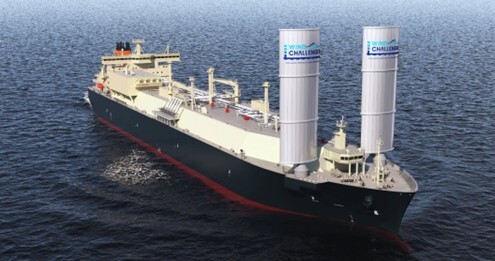 CG rendering of an LNG carrier equipped with two Wind Challenger sails (Source: MOL)
Development is also underway on a dedicated vessel design featuring the bridge positioned at the bow to optimize sail placement. By equipping the vessel with four sails, average annual fuel savings of 15–20% are projected, with peak reductions reaching approximately 30%.
1.2.jpg?width=700&height=351&name=%E3%82%A6%E3%82%A4%E3%83%B3%E3%83%89%E3%83%81%E3%83%A3%E3%83%AC%E3%83%B3%E3%82%B8%E3%83%A3%E3%83%BC4%E5%9F%BA%E3%82%92%E6%90%AD%E8%BC%89%E3%81%97%E3%81%9F%E6%96%B0%E8%88%B9%E5%9E%8B(%E3%82%A4%E3%83%A1%E3%83%BC%E3%82%B8%E5%9B%B3)1.2.jpg) CG rendering of the new ship design featuring four Wind Challenger units
CG rendering of the new ship design featuring four Wind Challenger units
(Source: MOL Press Release)
As a recent development, Approval in Principle (AiP) has also been obtained for a liquefied CO2 carrier equipped with three sails. A vessel transporting CO2 while being propelled by wind represents a symbol of a sustainable future.
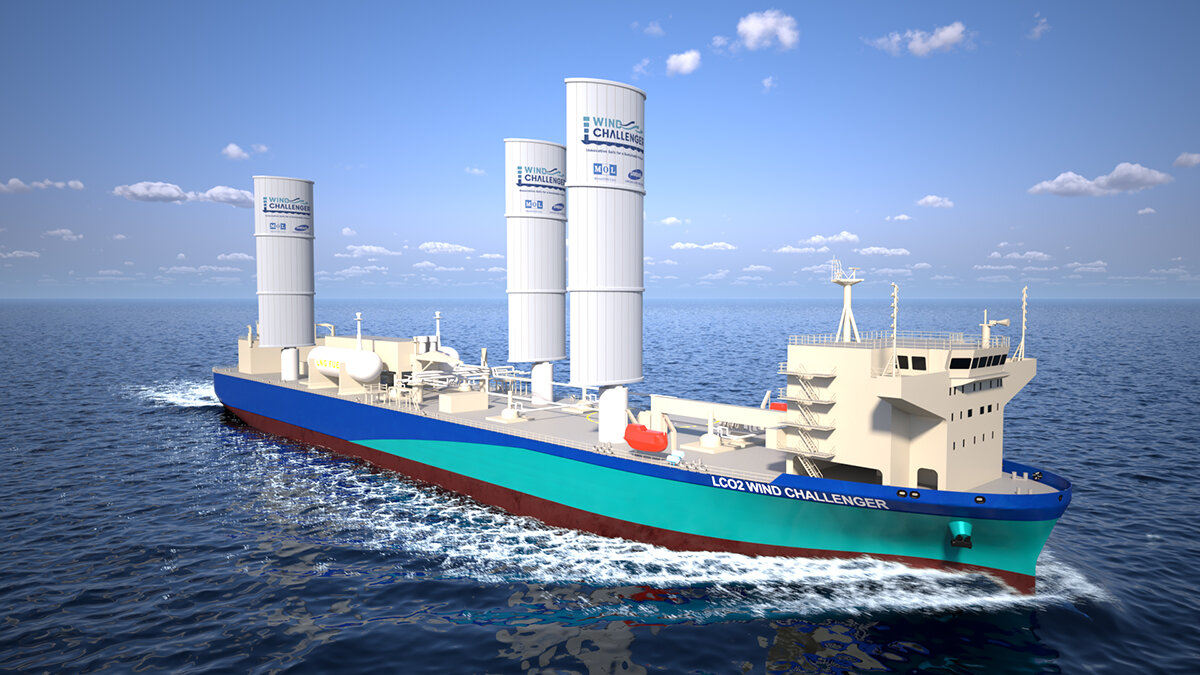
CG rendering of a liquefied CO2 carrier equipped with three Wind Challenger units
(Source: MOL Press Release)
80 Vessels by 2035: Toward the Future with Wind
MOL aims to deploy 80 Wind Challenger-equipped vessels by 2035.
“Taking on the future of the planet with the power of the wind.”
By combining the wisdom developed in the Age of Sail with the latest technologies, we will continue to lead cleaner maritime transportation.
We look forward to the continued progress of Wind Challenger.
DOWNLOAD/
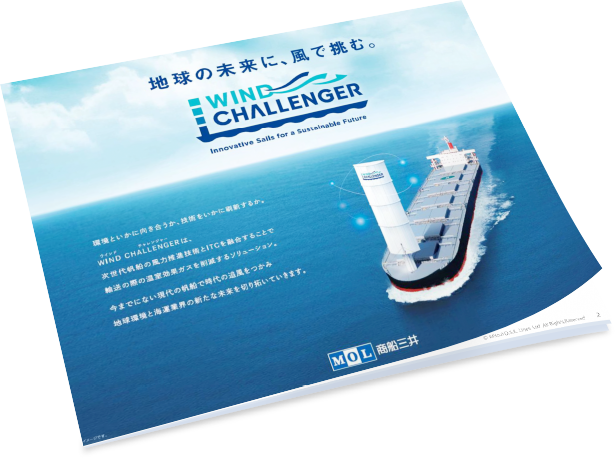
Wind Challenger Service Overview
You can download materials that provides an overview of the Wind Challenger, including its structure and the mechanism of wind-assisted propulsion.
.jpg)
The Wind Assisted Ship Propulsion System "Wind Challenger"
Wind Challenger, developed by MOL, is a wind-assisted propulsion solution that utilizes proprietary technology to automatically control the extension, retraction, and rotation of sails, harnessing the power of the wind.