BLOG
2026.06.02
Decarbonization in the shipping industry has entered a stage where we must consider not only "what fuel to use" but also "where and how that fuel is produced." The Mitsui O.S.K. Lines, Ltd.(MOL) Group is challenging itself to build a sustainable fuel cycle model by not only utilizing biofuels on existing vessels but also stepping into the "production" sites upstream in the supply chain.
In this article, Mércio Goenha, Branch Manager of the Maputo Office at MOL (Europe Africa) Ltd., shares a local perspective on the potential of biofuels emerging from Africa, starting from an encounter in Ghana.
Seeking the Potential of Biofuel in Africa——Background Behind the Author’s Interest in the Biofuel Business
Mércio Goenha
Branch Manager, Maputo Office, MOL (Europe Africa) Ltd.
I joined MOL (Europe Africa) Ltd. in 2022 as the first employee at the Maputo office, located in Mozambique’s capital city. Currently, I am responsible for monitoring and supporting London and Tokyo headquarters in matters relating to offshore business, with a particular focus on LNG carriers (LNGCs), FSRUs, and KARMOL projects.
 Maputo, Mozambique’s capital city on the Indian Ocean. Developed around its port, it is one of Southern Africa’s key urban centers.
Operating in a country that is relatively new to the LNG market, overseeing this sector has been an exceptional learning experience, which has also opened pathways into potential new business areas, including biodiesel and logistics. The development of biodiesel is in line with MOL’s decarbonization efforts by developing cleaner fuel sources. I believe that if its value-chain is well understood, Jatropha could be a strong candidate for such purpose with potential competitiveness.
%2c%20a%20non-edible%20oilseed%20plant%20used%20for%20biofuels.%20Photos%20of%20its%20fruit%20and%20flowers%20appear%20later%20in%20this%20blog.%20(1).jpg?width=600&height=449&name=Jatropha%20(Jatropha%20curcas)%2c%20a%20non-edible%20oilseed%20plant%20used%20for%20biofuels.%20Photos%20of%20its%20fruit%20and%20flowers%20appear%20later%20in%20this%20blog.%20(1).jpg) Jatropha (Jatropha curcas), a non-edible oilseed plant used for biofuels. Photos of its fruit and flowers appear later in this blog. (Photo by the author)
Jatropha (Jatropha curcas), a non-edible oilseed plant used for biofuels. Photos of its fruit and flowers appear later in this blog. (Photo by the author)
The Maputo office in Mozambique plays a key role in supporting MOL’s business development strategy and is tasked with assessing and monitoring business opportunities across the Southern Africa region. This expanded regional coverage strengthens MOL’s presence in a strategically important critical minerals region, positioning the company advantageously and diversifying its portfolio beyond its traditional core businesses.
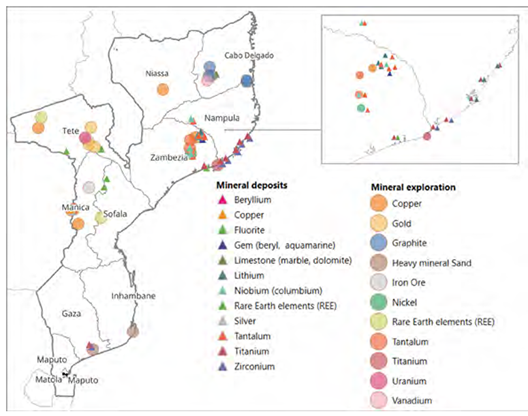 Distribution of major mineral deposits and mining areas in Mozambique (Source: Federal Institute for Geosciences and Natural Resources (BGR), The Mining Sector in Mozambique, 2025; original source: S. Lächelt).
Partnerships Connected by Jatropha - A Journey to Ghana Sparked by Intuition and an Encounter with a Japanese Company
In February 2023, I set out on a trip to Ghana that would mark a turning point in our biofuel business. What started almost as a hunch became an adventure into the future of sustainable energy crops.
We were invited to this adventure by Nippon Biodiesel Fuel Co., Ltd. (NBF), a Japanese company that has developed a unique model for local production and consumption of renewable energy, primarily using the non-edible Jatropha plant. NBF established its local subsidiary, Agro-business for Development of Mozambique Lda. (ADM), in March 2012 and initiated its Jatropha contract farming system around 2010.
Why Ghana? — The Answer Was in a Single Seed
Our destination was a remote area in Ghana, 400-km from Accra, the capital city of Ghana, where a company has been conducting groundbreaking research and development on Jatropha since 2015. Unlike many ventures that faltered in the biofuel sector, it persisted through years of genetic improvement, cultivating over 1,267 hectares of “marginal land”—areas unsuitable for food crops but ideal for resilient energy plants.
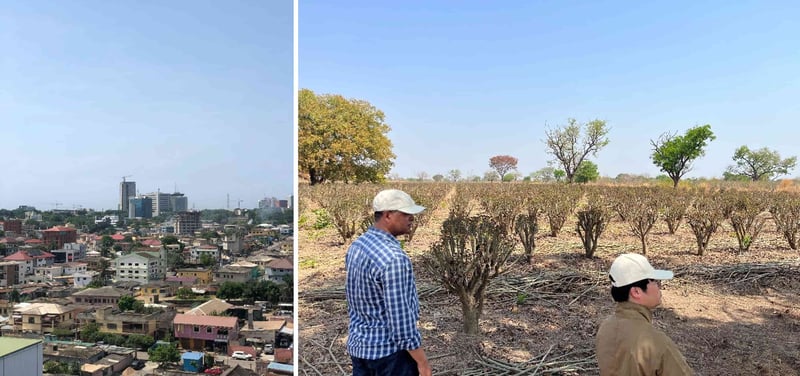
Left: The cityscape of Accra, the capital of Ghana, Right: A remote area in Ghana, about 400 km from Accra, where the author visited
(Photo by the author)
The highlight of our visit was the discovery of a rare, highly resilient Jatropha seed variety. The latest variety boasts seeds weighing 0.9 grams (up from 0.3 grams originally), with oil content increased to 39%. This breakthrough means significantly more biofuel per hectare alongside greater biomass for feedstock and fertilizer. Currently, the only company possessing this technology is NBF, which cultivates Jatropha in this region.
%20seeds%20and%20flowers..jpg?width=800&height=287&name=Jatropha%20(Jatropha%20curcas)%20seeds%20and%20flowers..jpg) Jatropha (Jatropha curcas) seeds and flowers. Each seed is typically about 2 cm in length and contains a high oil content. (Source: Wikimedia Commons, Ton Rulkens, CC BY-SA 2.0 / CC BY-SA 3.0)
Jatropha (Jatropha curcas) seeds and flowers. Each seed is typically about 2 cm in length and contains a high oil content. (Source: Wikimedia Commons, Ton Rulkens, CC BY-SA 2.0 / CC BY-SA 3.0)
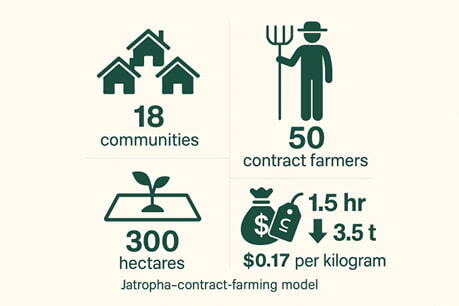
This model includes 50 contracted out-growers across 18 communities, cultivating about 300 hectares. Jatropha’s low labor requirements (1.5 hours/day) allow farmers to continue growing food crops while earning steady income and supporting rural livelihoods. Seeds were sold at $0.17/kg, with each hectare yielding up to 3.5 tons annually.
From Ghana to Mozambique — Building a Circular Model
Currently, NBF is focused on producing biofuel from Jatropha seeds, with a primary goal of supplying vessels through bunkering services. The company is considering starting biofuel production in Nampula province, Mozambique, and establishing a crushing facility at Nacala Port.%20in%20Ghana.jpg?width=800&height=450&name=During%20a%20first%20joint%20visit%20with%20NBF%2c%20aboard%20a%20Civitas%E2%80%90owned%20Floating%20Storage%20Unit%20(FSU)%20in%20Ghana.jpg) June 2025: During a first joint visit with NBF, aboard a Civitas‑owned Floating Storage Unit (FSU) in Ghana—an important step toward building a circular biofuel supply model linking Africa and Japan. (Photo by the author)
June 2025: During a first joint visit with NBF, aboard a Civitas‑owned Floating Storage Unit (FSU) in Ghana—an important step toward building a circular biofuel supply model linking Africa and Japan. (Photo by the author)
To achieve this, NBF is collaborating with Civitas (the agent for KARMOL, a joint project between MOL and Karpowership), which operates a Floating Storage Unit (FSU) for marine fuels.
Initial trials are scheduled for 2026, using Jatropha oil imported from Ghana before local production scales up. With discussions within the MOL Group and potential support from the Japanese government in mind, full-scale production is projected to begin around 2027.
Our visit was not only about learning—it was about building bridges between Africa and Japan. MOL has been closely involved with NBF’s development since their inception. This journey continues to evolve, demonstrating the priceless value of being part of MOL’s business development team.
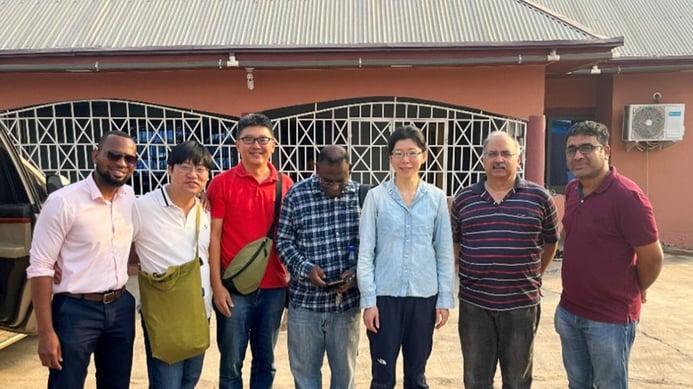
After an eight-hour drive, this photo was taken upon arrival at our accommodation in Accra. During the stay, the team shared a meal together, strengthening camaraderie.
From right: Dr. Yogendra Kumar Tripathi (Head of R&D), Mr. Uthama (Head of Plantation), Ms. Akiko Obata (Euglena), Dr. Jiregna (Head of Agronomy), Mr. Mitsuru Fukushima (MOL), Mr. Makoto Goda(Nippon Biofuel Co., Ltd./NBF) and Mercio Goenha (MOL).
(Photo by the author)
Heading Upstream in Fuel Strategy for Sustainable Shipping
The MOL Group is promoting decarbonization in maritime transport in a realistic and steady manner.
Among various options, biofuels are "drop-in fuels" that can be used without modifying existing ship engines, making them an extremely effective option for achieving low-carbon and decarbonized operations. MOL has already built a track record of steady greenhouse gas (GHG) reductions through voyages using biofuels in collaboration with resource majors such as Anglo American and BHP, including bunkering in Singapore. (press release, press release) Furthermore, in anticipation of future demand growth, we have begun establishing long-term supply and procurement systems in partnership with major players like SINOPEC in China and Marubeni. (press release)
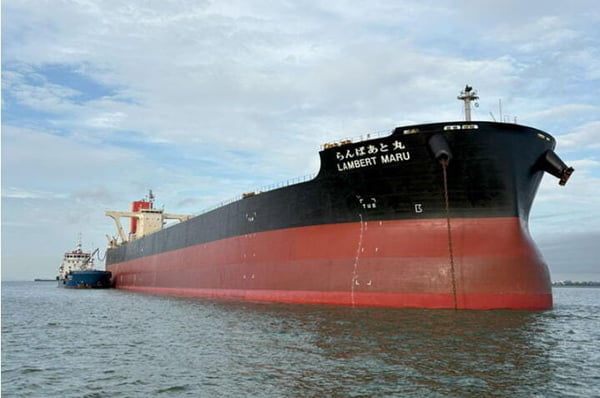 Biofuel-powered voyage of the capesize bulk carrier LAMBERT MARU, owned by MOL and operated for Anglo American. (Source: MOL’s press release)
The Jatropha project in Africa, introduced in this article, is part of this global strategy. It symbolizes MOL's challenge to go beyond the position of a fuel "user" and become involved from the "production" phase of the fuel supply chain. Establishing sustainable fuel production models in Ghana and Mozambique not only contributes to local job creation and economic development but also serves as a foundation for realizing the biofuel bunkering services planned for 2026 and beyond.
Through the adoption of alternative fuels and collaboration with a wide range of partners, MOL will continue to steadily advance initiatives that balance environmental responsibility with business sustainability, while looking toward the future of maritime transport.
Author Profile
Branch Manager, Maputo Office, MOL (Europe Africa) Ltd.
Mércio Goenha
Joined MOL (Europe Africa) Ltd. in 2022
The first employee at the Maputo office
Outside of work, he enjoys spending time in nature. Mozambique’s diverse landscapes and long coastline offer him opportunities to unwind and recharge, with Zavala Lake being one of his favorite places.

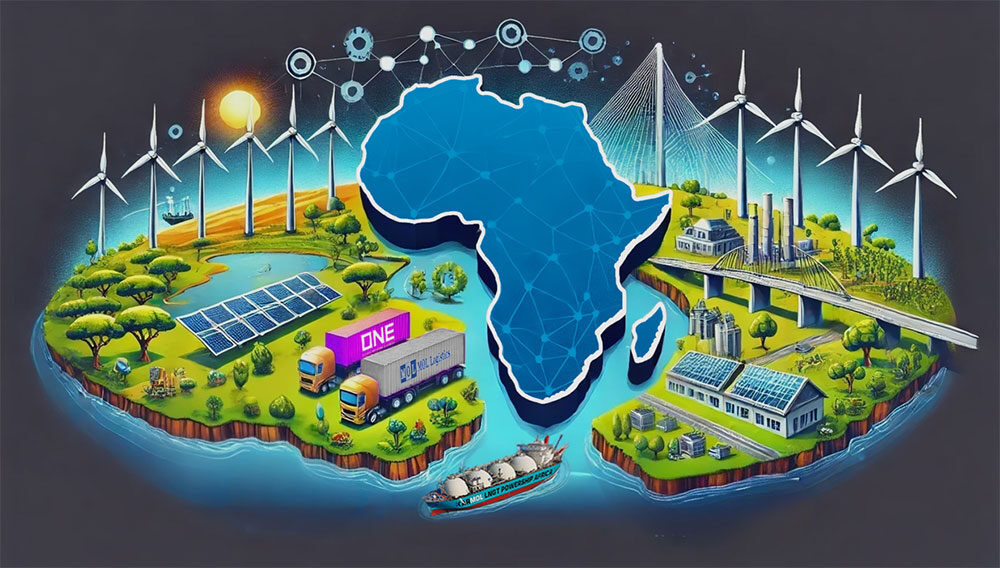
MOL Africa
Building Africa's Future.
Green Energy, Strong Supply Chains, and Infrastructure.

ADOPT ALTERNATIVE FUELS
MOL is focusing on the introduction and examination of a wide range of alternative fuels for vessels, and is steadily promoting efforts to reduce greenhouse gas (GHG) emissions from vessels.