BLOG
2026.11.17
Why did people come to enjoy not only traveling by ship, but also spending time aboard the ship itself?
If we trace the history of cruising, the answer can be found in 19th-century Europe. Ships that had previously been used to only transport cargo and people, gradually evolved into ships used for leisure and holidays, in other words developing into "resorts that sail the seas ".
Likewise, in Japan, a culture of sea travel aboard passenger ships developed through the eras of cargo/passenger liners and emigrant ships. This development closely overlaps with the history of the MOL Group's cruise ship business.
This article traces the beginnings of cruising around the world, the history of passenger ships and cruising in Japan, and the tradition of "FUNATABI -Beautiful encounters with Japan-" that lives on today through MITSUI OCEAN FUJI and MITSUI OCEAN SAKURA.
The Beginning of Cruises: From Transportation to Leisure Travel
The term "cruise" originates from the Latin word "crux (cross)", which carries the meaning of "crossing the great ocean." It later evolved into the Dutch word "kruisen" and is said to have taken its present form, "cruise," in 17th-century England.
Following the Age of Discovery associated with explorers such as Columbus and Magellan, ships began transitioning from being merely a means of transporting cargo and people to becoming an option for leisure travel around the 1840s. The British shipping company P&O (Peninsular and Oriental Steam Navigation Company) is generally credited with launching the first such cruise in 1844, sailing from the United Kingdom to the Mediterranean and visiting destinations that included Greece and Malta.
Around the same time, shipping companies such as Britain's Cunard Line and the Hamburg America Line (now Hapag-Lloyd AG, which specializes in the containership business) were established. In 1867, the paddle steamer Quaker City offered a pilgrimage cruise to and from New York that also included a visit to the Paris Exposition, marking the emergence of cruises in which the voyage itself was the purpose.
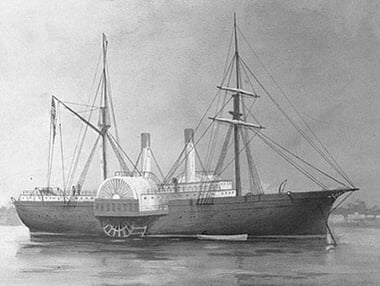
Wikipedia “USS Quaker City”
Quaker City during the American Civil War (painting): 1,451 tons, overall length 74.57 m. Although it may appear small by today's standards, it was one of the most advanced ships of its time. By comparison, MITSUI OCEAN SAKURA, which entered service in 2026, has a gross tonnage of 34,138 tons (approximately 22 times larger) and an overall length of 198.15 m (approximately 2.7 times longer). The comparison illustrates just how much cruise ships have evolved.
In Japan, Osaka Shosen Kaisha (OSK Line), a predecessor of Mitsui O.S.K. Lines (MOL), was established in 1884, followed by Nippon Yusen Kaisha (NYK) in 1885. All ships at the time were cargo/passenger liners carrying both cargo and passengers, which means that MOL has offered passenger services at various locations in the Seto Inland Sea since its earliest days. OSK Line's first international route was the Osaka–Incheon route, launched in 1893. The first long-distance passenger services were NYK's European route, which began in 1896, and OSK Line's Hong Kong–Tacoma (Washington State) route, which began in 1909.
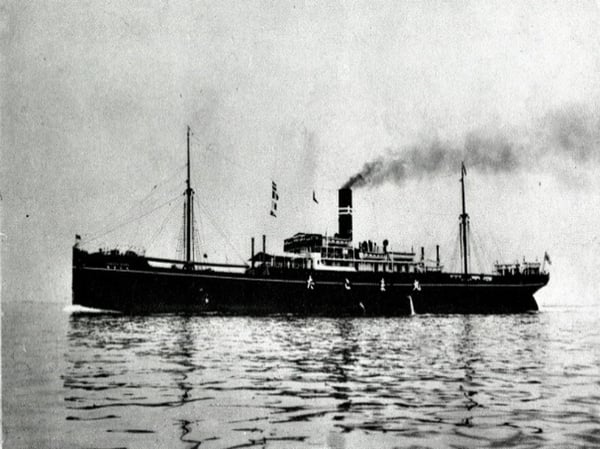 Tacoma Maru, the first vessel on the Hong Kong–Tacoma route that OSK Line started in 1909: 6,178 tons, overall length 127.18 m. (Owned by MOL)
As the famous Titanic illustrates, passenger ships around the world gradually became larger and their interiors more luxurious from the mid-19th century through the first half of the 20th century. From the 1920s onward, the transition from steamships to diesel-powered ships also progressed. In November 1925, the Swedish American Line (Sweden) put the Gripsholm, the world's first diesel-powered cargo/passenger liner, into service. The following month, in December of the same year, OSK Line began operating the first-generation Santos Maru, Japan's first diesel-powered cargo/passenger liner.
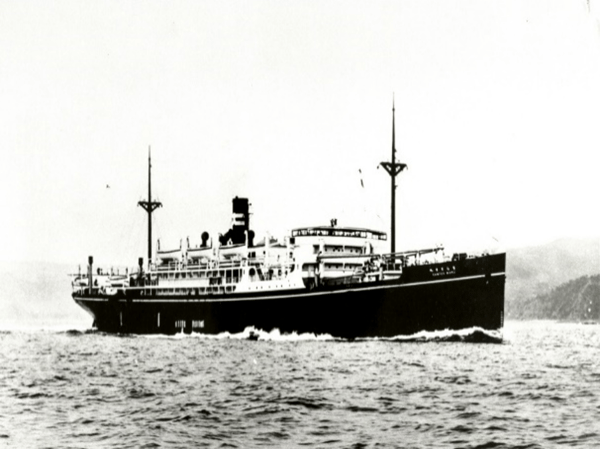 Santos Maru (First Generation), Japan's first diesel-powered cargo/passenger liner: 4,386 tons, overall length 136.6 m. (Owned by MOL)
From the Postwar Period to Today: The Era of Resorts Sailing the Seas
After the two World Wars, many of the world's passenger ships had been lost through requisition or sinking. In the 1950s, advances in aviation gradually led the number of air travelers to surpass the number of people traveling by sea. However, as major shipping companies around the world shifted their management focus toward cargo transportation, they began to treat cruise operations as a distinct source of revenue. The cruise industry started pursuing ship designs that could be described as hotels or resorts sailing the seas, moving toward the form of the modern cruise ship.
Many of today's major cruise lines were established from this period onward. In particular, the popularity of cruising in the United States around 1980 was sparked by the success of the television series The Love Boat (1977–1990), filmed aboard the Pacific Princess operated by Princess Cruises. The period after the 11 September 2001, terrorist attacks in the United States, when many people avoided vacations involving air travel, is also said to have contributed to the rise in popularity of cruising.
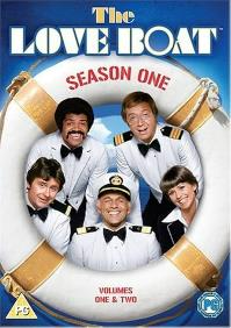 The Love Boat DVD (from Amazon.co.jp)
Postwar Japan and the Birth of Mitsui O.S.K. Passenger Line
After the San Francisco Peace Treaty came into effect in 1952, Japan resumed its national policy of promoting emigration to South America, and passenger ships continued to serve as emigrant ships. OSK Line had restarted its South American route using cargo ships in 1950 with GHQ approval, but the business environment during the postwar reconstruction period was far from ideal.
To address operating deficits, OSK Line established Japan Emigration Ship Co. as a separate company in 1963 and transferred ownership of five cargo/passenger liners built under the postwar planned shipbuilding program*1 to the new company. Mitsui O.S.K. Lines, established in 1964 through the merger of OSK Line and Mitsui Steamship, Japan Line, Ltd., then bareboat-chartered these vessels and continued transporting emigrants to South America.
(*1)
A post-World War II policy implemented by the Japanese government that used public funds and loans to promote the planned construction of merchant ships by shipping companies.
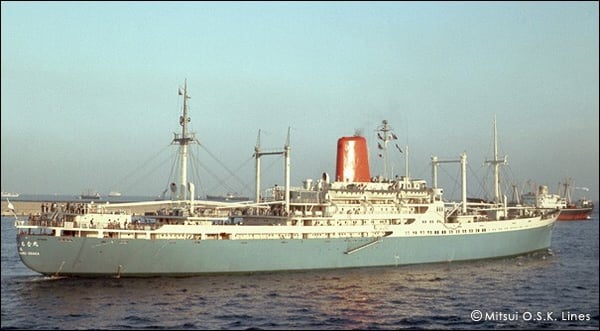 Argentina Maru, one of the five vessels: America Maru, second-generation Santos Maru, Brasil Maru, Argentina Maru, and Sakura Maru. (Owned by MOL)
As Japan's economic growth led to a gradual decline in the emigration business, MOL transferred its passenger shipping division to Japan Emigration Ship Co. in 1970, and the company was renamed Mitsui O.S.K. Passenger Line, Ltd. In 1972, Argentina Maru was converted into a dedicated passenger ship and entered service as the first-generation Nippon Maru. In 1973, Japan's first postwar round-the-world cruise by a Japanese passenger ship was carried out, and the emigrant ship business officially ended with this voyage.
This can be regarded as the beginning of the MOL Group's modern passenger ship business. Mitsui O.S.K. Passenger Line, Ltd. subsequently continued to offer cruises with a succession of vessels, including the second-generation Nippon Maru (1977), New Sakura Maru (1981), Fuji Maru (1989), and third-generation Nippon Maru (1990).
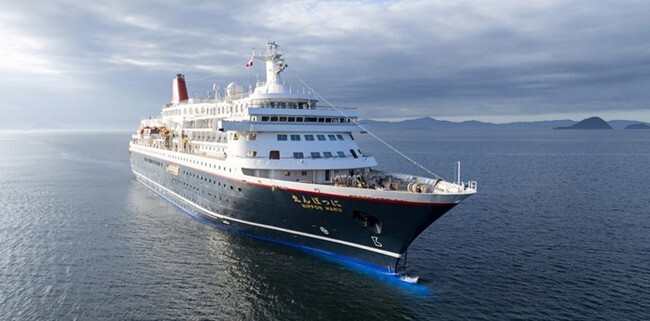
The third-generation Nippon Maru retired in May 2026. (Source: MOL press release)
The History of Cruising Continues with MITSUI OCEAN CRUISES
Building on this history is MITSUI OCEAN CRUISES, the cruise brand operated today by MOL Cruises.
MITSUI OCEAN FUJI entered service in December 2024. The ship has 229 cabins and can accommodate 458 guests. MITSUI OCEAN SAKURA, a new cruise ship, entered service in September 2026. Operating as a Japanese-registered vessel, MITSUI OCEAN SAKURA offers many short cruises, with itineraries as short as one night.
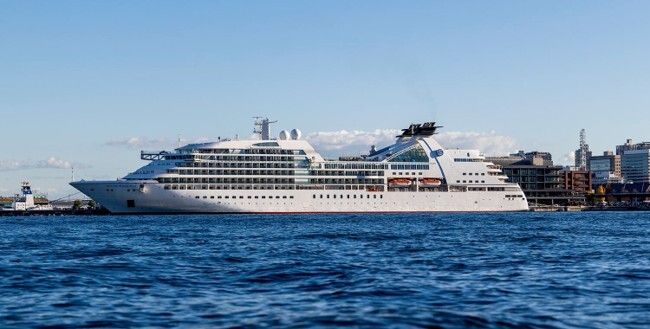 MITSUI OCEAN FUJI (Source: MOL press release)
MITSUI OCEAN CRUISES is a cruise brand that carries forward the service and value of sea travel developed over many years while offering cruise experiences for a new era. MITSUI OCEAN FUJI and MITSUI OCEAN SAKURA are characterized by the attentive hospitality, "Omotenashi", cultivated through more than 140 years of passenger ship operations, including the cargo/passenger liner era. Their maneuverable size also enables them to call at ports and remote islands throughout Japan. Through voyages that offer encounters with Japan's beautiful coastlines and regional cultures, they carry the appeal of "FUNATABI -Beautiful encounters with Japan-" forward to the next generation.
Time spent at sea, encounters at ports of call, and hospitality unique to Japan, the history of cruising will continue with new journeys and adventures at sea.
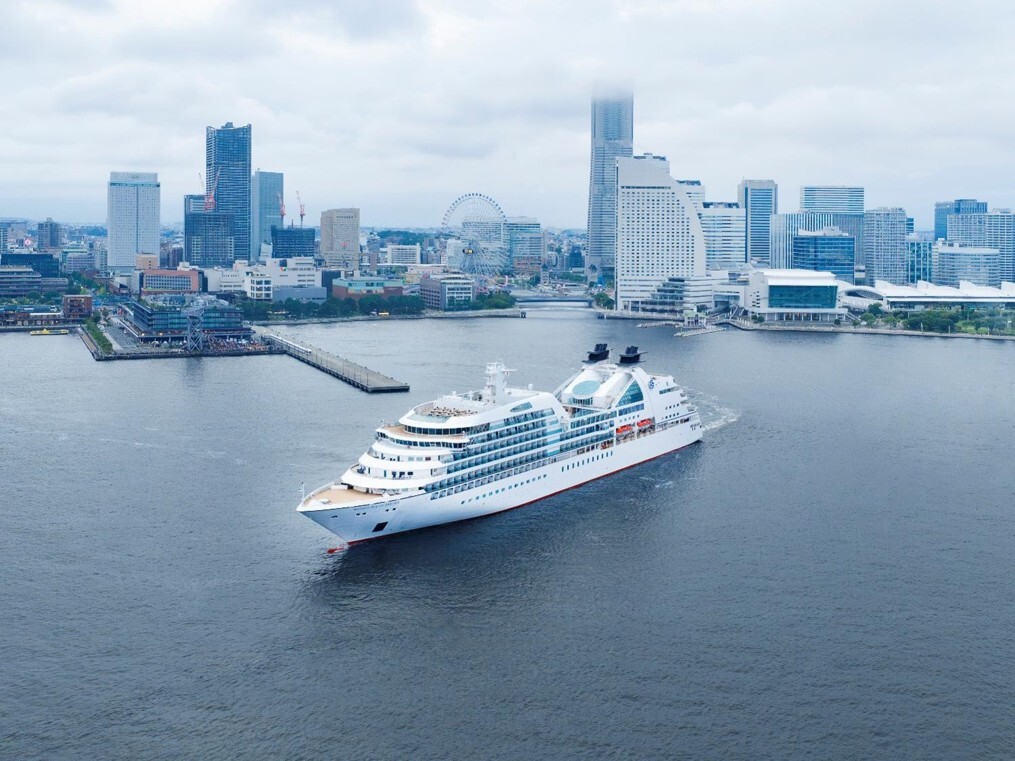
MITSUI OCEAN SAKURA (Source: MITSUI OCEAN CRUISES)
In cooperation with: MITSUI OCEAN CRUISES *Japanese Only


[The Hidden Story of Journeys at Sea and Logistics] MOL Sunflower Shapes Our Lives and the Future