BLOG
2026.01.20
LNG (Liquefied Natural Gas)-fueled vessels are being introduced as environmentally friendly ships, as they emit lower levels of sulfur oxides (SOx), nitrogen oxides (NOx), and particulate matter compared to conventional heavy fuel oil vessels. However, engines powered by LNG face a unique challenge known as “methane slip.” Is there a solution to this issue?
What is Methane Slip?
Methane slip refers to the phenomenon where methane, the main component of LNG fuel, is not fully combusted in the engine and is released into the atmosphere as unburned methane in the exhaust gas. Methane slip also refers to the methane itself that is emitted without combustion. Methane is a greenhouse gas with a global warming potential approximately 25 times greater than that of carbon dioxide (CO₂). Therefore, its impact on global warming cannot be ignored.
Overview of MOL’s Initiatives
Mitsui O.S.K. Lines (MOL), in collaboration with Kanadevia Corporation and Yanmar Power Technology Co., Ltd., has been selected for the “Development of Next-Generation Vessels” project by the New Energy and Industrial Technology Development Organization (NEDO). The project aims to develop methane slip reduction technology. By combining a methane oxidation catalyst system (explained below) with engine improvements, the goal is to achieve a methane slip reduction rate of 70% or more for LNG-fueled vessels.
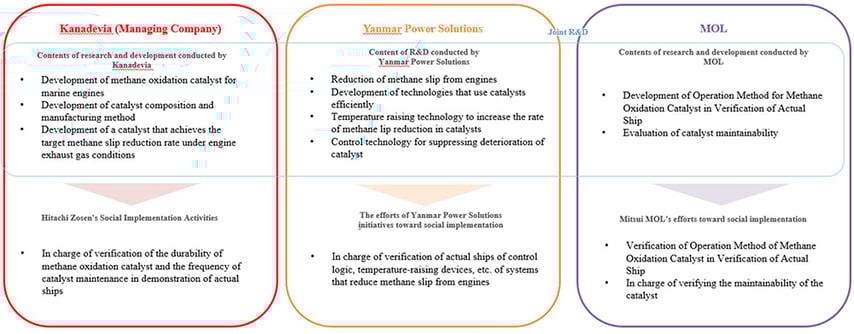
Reference: Roles of each company in the Project and their efforts toward social implementation (Source:MOL Press Release 98% Methane Slip Reduction from LNG-fueled vessels Achieved in Onboard Trials Onboard trials to continue through FY2026, aiming for social implementation from FY2027 onwards
)
Achieving 98% Reduction in Onboard Trials
In May 2025, MOL began full-scale demonstration trials using the LNG-fueled large coal carrier “REIMEI” on routes between Japan and Australia. The “REIMEI,” delivered in 2023 by Namura Shipbuilding Co., Ltd., is engaged in coal transportation for Kyushu Electric Power Co., Inc.

.jpg?width=665&height=443&name=LNG%E7%87%83%E6%96%99%E5%A4%A7%E5%9E%8B%E7%9F%B3%E7%82%AD%E5%B0%82%E7%94%A8%E8%88%B9REIMEI(%E8%8B%93%E6%98%8E).jpg)
LNG-fueled large coal carrier REIMEI
In these trials, the methane oxidation catalyst system developed in land-based tests was modified for onboard use and its performance was evaluated under actual operating conditions. As a result, a methane slip reduction rate of 98% was achieved, far exceeding the target of 70%.
Onboard trials are subject to variable weather and operational conditions, causing constant changes in engine room environment and engine load. Even under these conditions, the system achieved a higher reduction rate than the 93.8% achieved in land-based tests in 2024.
2.jpg?width=665&height=443&name=LNG%E7%87%83%E6%96%99%E5%A4%A7%E5%9E%8B%E7%9F%B3%E7%82%AD%E5%B0%82%E7%94%A8%E8%88%B9REIMEI(%E8%8B%93%E6%98%8E)2.jpg)
Full-scale demonstration trials with REIMEI have begun in waters between Japan and Australia
Mechanism of the Methane Oxidation Catalyst System
The methane oxidation catalyst system is a technology that places a methane oxidation catalyst in the exhaust pipe of LNG-fueled engines or generators, oxidizing unburned methane on the catalyst to reduce methane slip. By combining this system with Exhaust Gas Recirculation (EGR) technology, which recirculates engine exhaust gases, the reduction rate is further improved.
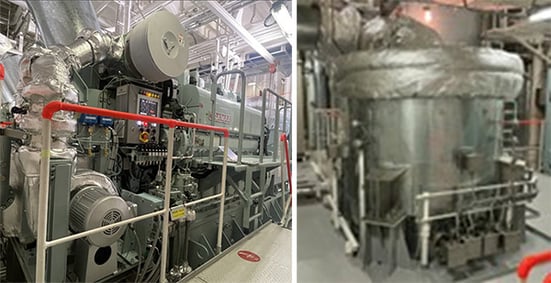 Methane slip reduction system on board,
Left: EGR system, Right: Methane oxidation catalyst layer
Future Outlook
MOL will continue onboard trials through the end of FY2026 to evaluate catalyst durability and overall system performance. The company aims to implement this technology in society from FY2027 onwards, contributing to greenhouse gas emission reductions in the maritime sector and promoting the realization of a low-carbon society.
Column from the MOL Group
FROM CURIOSITY TO COMMITMENT: MY FIRST STEPS IN MARITIME SUSTAINABILITY
Lisa De Klerk / HR & General Affairs, MOL Maritime (Europe) b.v.
 My father and grandfather were both seafarers who sailed with the Holland America Line. My father’s stories have always stayed with me, and my love for ships began at a young age. Starting my career at MOL Group felt like an honour, a step in the footsteps of my family.
Although I had no background in shipping, containers, routes, and vessel types were all new to me, I knew one thing for sure: I wanted to work for a company that takes sustainability seriously. I quickly discovered that MOL Group does not just talk about going green, they truly act on it.
I came across projects I had never even considered before. At work, I learned that we operate both LNG carriers and oil tankers, and that LNG, or liquefied natural gas, significantly reduces CO₂ and particulate emissions compared to conventional fuels. What struck me most was learning that LNG ships are not entirely sustainable, and that MOL is working with Kanadevia and Yanmar on a particularly innovative project to drastically reduce methane slip. I had never heard of methane slip, let alone that it is such a major climate issue. The fact that MOL is leading globally in this area makes me feel both proud and curious..jpg?width=296&height=480&name=Ms%20Lisa%20De%20Klerks%20grandfather%20(1).jpg)
I do not work in Research and Development. I am an administrator in HR at MOL Maritime (Europe) b.v. Still, I have noticed that sustainability here is not just an abstract idea. It is present in conversations, in projects, and in the company’s ambition. If we are making such big strides in technology, how do we make sure that this story is not just shared on websites and press releases, but also truly understood and embraced by everyone at MOL, from office to ship? At first, I was surprised by how much I still had to learn about something as central as LNG. But I have come to see that asking questions and staying curious is not a weakness — it is a strength, and a necessary part of building a culture of sustainability.
When I read about the 98 percent reduction in methane slip, I was impressed, but also a bit overwhelmed. It is technical, complex, and far removed from my daily work. Yet I felt that this matters to me. Because if we as a company are taking such bold steps, I want to understand what that means. Not just for the climate, but also for how we collaborate, communicate, and grow. Sustainability is not just a technical challenge, it is a human one.
I joined MOL Group without any knowledge of shipping, but with a curious mindset. What I have discovered is that you do not need to be an engineer to care about sustainability. You just need to be willing to learn, to ask questions, and to help carry the story forward. That is the purpose of this blog: to learn, reflect, and share.
Welcome to the World of Ships! Special Feature on Various Vessels — Celebrating the Opening of Mitsui O.S.K. Lines’ Interactive Museum “Funeshiru”
.jpg)
What is a Tugboat? Exploring the Tugboat Business of Mitsui O.S.K. Lines!
What Is Carbon Dioxide Removal (CDR)? MOL Explains — Making Sense of Reduction and Removal